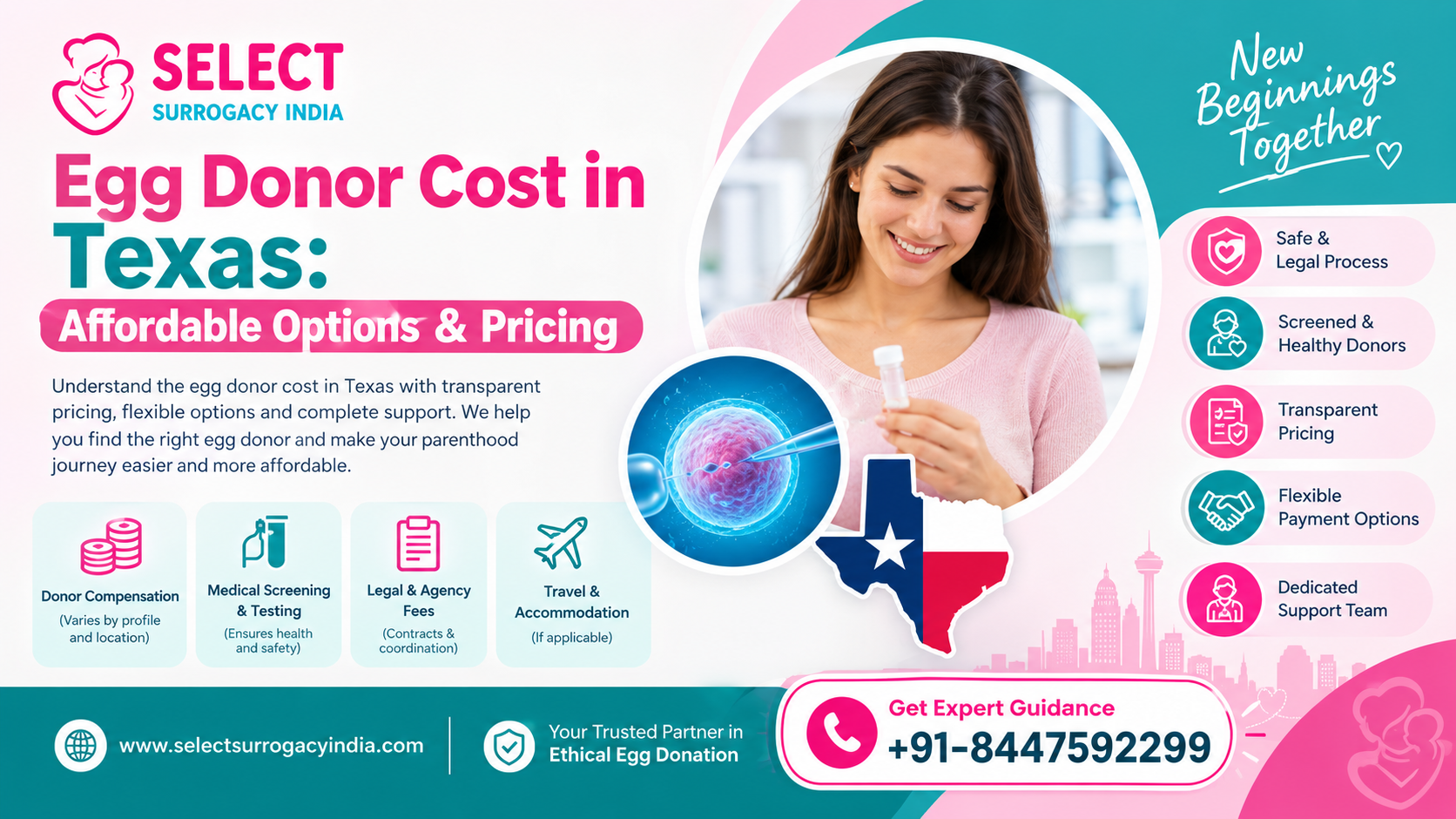
Egg Donor Cost in Texas: 2026 Pricing Guide
If you are researching egg donor cost in Texas, understanding the total expenses involved can help you plan your fertility treatment budget. The cost of using an egg donor can vary depending on the donor program, fertility clinic, donor compensation, medical screening, medications, IVF treatment, and other services included in your treatment plan.
In Texas, egg donation costs are not always presented as one fixed price. Some programs quote donor-related expenses separately, while others may provide packages that include several donor services. Additional expenses such as IVF, fertility medications, laboratory procedures, embryo testing, freezing, and embryo transfer may also apply.
In this guide, we explain egg donation costs in Texas in 2026, what is typically included in a donor program, which expenses may be charged separately, and the factors that can affect your overall budget.

How Much Does Egg Donation Cost in Texas?
The cost of egg donation in Texas can vary depending on the donor program, fertility clinic, services included, and the treatment plan. Based on published Texas program pricing, donor-related costs may be around $18,000 to $28,000 or more, while the total cost can increase when IVF treatment, medications, laboratory services, embryo testing, freezing, and embryo transfer are added.
It is important to understand that egg donor cost and total donor-egg IVF cost are not always the same. Some programs quote donor-related expenses separately, while other packages may include multiple services.
Egg Donation Cost in Texas at a Glance
| Cost Category | What It May Include |
|---|---|
| Donor program | Donor selection and program-related services |
| Donor compensation | Compensation paid to the egg donor |
| Medical screening | Medical, genetic and fertility-related testing |
| Donor medications | Medications used during the donor cycle |
| Egg retrieval | Medical procedure to retrieve eggs |
| IVF treatment | Fertilization and laboratory treatment |
| ICSI | Additional laboratory procedure when recommended |
| Embryo testing | PGT or other testing, when selected |
| Embryo freezing & storage | Freezing and ongoing storage |
| Embryo transfer | Transfer of an embryo to the intended mother |
Important: These are planning figures, not a guaranteed quote. Actual costs vary by clinic, donor program, treatment plan and services included. Ask for an itemized estimate before starting treatment.
What is Donor Egg IVF?
Donor egg IVF is a fertility treatment in which eggs from a donor are fertilized with sperm to create embryos. An embryo is then transferred to the intended mother’s uterus or, when medically appropriate, to a gestational carrier. The donor provides the eggs, but does not carry the pregnancy.
Women may consider donor egg IVF when they have diminished ovarian reserve, reduced egg quality, advanced maternal age, primary ovarian insufficiency, or repeated unsuccessful IVF cycles. Donor eggs may also be considered when there is a significant risk of passing certain genetic conditions to a child. Using donor eggs can provide another treatment option when a patient’s own eggs are unlikely to result in a successful pregnancy.
Every woman considers this process very cautiously.
Women may take a long time to emotionally accept the use of donor eggs. Women have described a long process of dealing with grief for the genetically related children they would not be able to carry. They may need to find ways to identify new paths to fulfill their desire to have children.
A fertility clinic should take into account the fact that patients need time to process the emotional and logistical consequences of donor conception.
Egg Donor Medical Screening in Texas
Before an egg donor can undergo treatment, medical testing is done to evaluate if there are any medical or genetic conditions that may put the donor or intended parent at risk. It is also done to ensure that the donor is a good candidate for the process. Based on the results of the screening, treatment may be adjusted to ensure safety of all parties.
Screening involves a number of different processes such as taking a medical history, physical exams, blood tests, and more.
Screening processes also vary between fertility clinics.
Some, but not all, clinics also screen donors for genetic conditions.
Being an Egg Donor is a lengthy and costly process due to screening. Some of the money paid to donors goes toward the costs of screening.
There are also a number of medical personnel and support staff required to perform tests, monitoring, and administrative work.
Genetic Testing for Egg Donors Before IVF
There are several genetic conditions that may run in a family. Genetic testing of a potential donor may help identify potential conditions a child may be at risk of inheriting.
It is important to understand that no testing can eliminate the possibility of a child inheriting a genetic condition.
Genetic testing may also identify if a donor is a carrier of a genetic condition.
Intended parents may also elect to be genetically tested to assess their condition and the donor’s condition in combination. A fertility specialist or genetic counselor may be able to provide additional information.
There are numerous factors to consider in these situations and it can become very overwhelming. Don’t hesitate to reach out and seek the help of a medical professional.
Psychological and Emotional Considerations in Egg Donation
Egg donation is a medical journey, but there are emotional components of the process that deserve recognition.
Some women are able to conceive and carry a pregnancy to term using their own eggs; therefore, an egg donation diagnosis is often unexpected.
Some women experience relief knowing alternative options exist.
Others experience sadness, uncertainty, and even guilt.
Some potential egg donor recipients are concerned about how they will bond with a child who is biologically unrelated to them.
It is important for women considering egg donation to be aware of the possible emotions they may experience as a result of this meaningful decision.
Counseling may assist women in working through these emotions. The focus of the counseling is to clarify emotions, and to set appropriate expectations about treatment.
Preparing the Egg Donor for IVF
The egg donor undergoes a series of examinations to ensure she is medically appropriate to donate.
Egg donation requires the stimulation of the ovaries to produce and/or enhance the development of multiple mature eggs.
This process is monitored by the fertility clinic through a series of blood tests and ultrasounds to assess the ovaries’ response to the stimulation medications.
The length of this process varies for each individual. The goal of this process is to harvest multiple mature eggs for in vitro fertilization.
The dosage is modified based on the donor’s response.
This is another reason donor egg treatment is not an expenditure with an exact cost. Once the eggs are retrieved, the donor continues to be under our care and monitoring.
Egg Retrieval Procedure for Donor Eggs
To finish the maturation process of the ovarian follicles and to prepare them for the process of being ended from the ovaries, a hormonal injection is given to the donor.
Eggs are retrieved under ultrasound control by a skilled physician.
As the retrieval procedure is done under ultrasound control and without anesthesia it can be painful and unpleasant for the donor. To alleviate this, donors are given sedatives or anesthetics.
The donor’s role in the treatment process is completed and she is discharged to recover. Embryos are transported to the embryology laboratory for further processing.
What Happens After Egg Retrieval?
The next step in the treatment process, embryology division’s responsibility, is to evaluate the eggs for quality and further instruct the process.
If the eggs are to be used fresh, then the sperm (of the intended father or a donor) is permitted to enter the eggs for fertilization.
If the eggs are to be used frozen, they have to undergo a process called embryo thawing in the embryology division’s laboratory.
Not all the eggs can survive all the processes.
The amount of eggs retrieved does not guarantee the amount of embryos available for transfer. There are numerous phases between egg retrieval and embryo transfer.
Once retrieved eggs are prepared for fertilization.
In some cases, it may be deemed appropriate for the intended father to provide a semen sample for fertilization of the donor eggs.
The method of fertilization is determined by the fertility specialist based on the case in question.
Fertilization may occur via conventional in-vitro fertilization (IVF) or Intracytoplasmic Sperm Injection (ICSI).
It is important that patients confirm if the cost of fertilization is included in the donor egg package prior to making their donor egg selection based on cost.
It is important to understand the cost of fertilization when evaluating fertility clinics located in the state of Texas.
The embryology team will evaluate the embryos and determine if they are fit for further processing or embryo transfer.
It may be uncomfortable for the intended parents to undergo the embryology team’s evaluation and await the outcome, however, it is during this time the embryology team determines which of the available embryos are best for treatment and transfer.
Through this process, one may start with several eggs, fewer fertilized eggs, and eventually, still fewer embryos. This is expected and normal. The fertility team must provide this explanation to the patient in order to alleviate concerns.
Embryo Freezing and Storage After Donor Egg IVF
Some embryos can be frozen and stored for use later. Freezing embryos is another form of embryo preservation.
Freezing embryos can be useful to store embryos for transfer at a later time. It can also be useful to freeze embryos while waiting for the results of further testing.
It should be noted, that freezing embryos also adds to the cost of treatment.
When speaking with your fertility clinic, be sure to inquire about the following:
Will freezing of embryos be included in the cost of treatment?
How much will embryo storage cost?
How long will the first embryo storage be free of charge?
How much will it cost to store embryos each year?
How much will it cost to transfer frozen embryos?
You should ask these questions prior to treatment, so that you are fully informed.
PGT With Donor Egg IVF
Some patients may wish to consider pre-implantation genetic testing (PGT) in conjunction with their donor egg IVF cycle.
PGT may be applicable to some cases, however, it may not be necessary in all cases where donor eggs are utilized.
There may be several reasons why your doctor may recommend PGT to you. It is important that you understand what type of genetic testing will be performed, and the overall benefits to your case.
PGT does not guarantee a healthy baby. It is important to understand the limitations of any and all genetic testing that may be performed.
Because of the nature of PGT, it may increase the cost of your treatment.

Preparing for Embryo Transfer With Donor Eggs
The intended mother will also need some preparation for embryo transfer. The lining of the uterus needs to be prepared in order for it to be thin enough to receive the embryo for implantation.
Hormonal medication may be part of your treatment.
Once the treatment begins, your doctor will perform or order ultrasounds to assess the endometrium.
The details of your treatment plan will change the details of your treatment.
Some patients will require additional testing or treatment before a transfer can occur.
Because of this, donor egg IVF can be seen as two separate processes, the egg donor process and the recipient process.
As part of the recipient process, the endometrium is prepared to receive a donor egg. Once this is accomplished, an embryo can be created and transferred.
The egg transfer is less invasive.
A catheter will be used to place the embryo in the prepared uterine cavity.
You will need to wait before having pregnancy testing to determine if the transfer was successful.
During this time you may become very anxious and stress about every little thing.
It is important to remember that the symptoms you may be feeling are likely due to the hormonal medication and not pregnancy.
The staff at your fertility clinic will let you know when you can take a pregnancy test and for how long you will need to wait to take the test. They will also give you further instructions about your medication.
How Much Does Egg Donor Treatment Cost in Texas?
The cost of egg donor treatment in Texas can vary significantly depending on the donor program, fertility clinic, services included in the package, and the treatment plan recommended for the intended parent or parents.
An egg donor package is not always the same as the total cost of donor egg IVF. Some programs may include donor screening, medical testing, donor medications, egg retrieval and donor compensation, while recipient-side expenses such as IVF, ICSI, fertility medications, embryo testing, freezing, storage and embryo transfer may be charged separately.
For this reason, patients comparing egg donor cost in Texas should look beyond the advertised package price and request an itemized estimate showing which services are included and which may result in additional charges.
Typical Expenses to Consider
| Expense | How It May Affect Your Budget |
|---|---|
| Donor program or donor-related fees | May cover donor screening, medical care, retrieval and compensation depending on the program |
| IVF treatment | May be charged separately from the donor program |
| Fertility medications | Additional medication costs may apply to the treatment cycle |
| ICSI | May be recommended depending on the fertility specialist’s assessment |
| Embryo testing/PGT | Additional cost if genetic testing is recommended or selected |
| Embryo freezing | May be charged separately |
| Embryo storage | Usually an ongoing expense when embryos are stored |
| Frozen embryo transfer | Additional treatment expense when a frozen embryo is transferred |
| Donor agency or coordination fees | May be included in the program or charged separately |
| Legal and counselling expenses | May vary depending on the donor arrangement and services required |
The final cost should therefore be evaluated as a complete treatment plan rather than by comparing one donor package price with another.
What Is Included in Egg Donor Cost in Texas?
An advertised egg donor package does not always represent the complete cost of donor egg IVF in Texas. Depending on the fertility clinic or donor program, the package may include donor screening, medical testing, donor medications, egg retrieval and donor compensation, while recipient-side treatment expenses may be charged separately.
Additional costs may include IVF treatment, fertility medications, ICSI, embryo testing or PGT, embryo freezing, storage and frozen embryo transfer. This is why patients should review each package carefully and ask which services are included before comparing prices.
Different fertility clinics and donor programs may structure their fees differently. A service that is included in one program may be charged separately by another. Patients should therefore ask for a written, itemized estimate before beginning treatment.
The estimate should clearly identify the donor-related costs as well as any expected recipient-side expenses, including IVF, medications, ICSI, embryo testing, freezing, storage and embryo transfer.
How to Plan Your Egg Donor Cost in Texas
Planning your egg donor cost in Texas should include more than the advertised donor package price. Before starting treatment, consider donor-related fees, IVF treatment, fertility medications, embryo testing, embryo freezing and storage, and embryo transfer costs.
You should also consider practical expenses such as travel, accommodation and additional clinic visits if you are traveling to Texas for treatment. International patients may need to plan for a longer stay or more than one trip, depending on the treatment schedule and the clinic’s requirements.
Creating a complete budget in advance can help you understand your expected out-of-pocket expenses and reduce the chance of unexpected costs during treatment.
Ask the clinic how many visits are expected, and if some monitoring can happen in a location that is more convenient.
Different clinics have different policies when dealing with patients who live far away.
If you have some forewarning about specific aspects of your treatment, you can often adjust to alleviate some stress.
How to Compare Egg Donor Programs in Texas
Because there are many fertility clinics in Texas, prospective patients have the opportunity to do a significant amount of research in order to determine which clinic best meets their requirements.
Choosing the clinic with the lowest donor compensation or availablity, or the most advertised discounts, is not always in the best interest of the patient.
Other factors to consider include the quality of the medical personnel, the available information on donors, and the clinic’s genetic and IVF lab testing.
Determining who will manage the patient’s care and ensuring that adequate communication processes are in place are also essential.
Finally, the total out-of-pocket costs to the patient need to be considered when evaluating different clinics. A clinic quoting a total of $20,000 is not necessarily more expensive than one quoting $15,000.
While there are likely differences in the services offered in the different packages, the comparison should be at the package level, rather than at the number level.
International Patients
International patients considering donor egg treatment in Texas should also include travel and accommodation expenses when planning their overall treatment budget. Depending on the treatment schedule, patients may need to account for medical visits, local transportation, accommodation and additional travel.
Choosing an Egg Donor Program: What to Consider
While many factors make a program unique, typically, the kind of guidance provided to patients, during their journey to understand various options available to them, makes the most significant difference. It is equally important for patients to feel secure about the travel, treatment cost, and other logistics related to their intended journey.
Select IVF India, from the preliminary information available to the public, seems focused on assisting patients by providing clear information on the different aspects of donor assisted reproduction. Information related to third party donation including screening of donors is available on their site.
As mentioned earlier, experience shows that the kind of support provided to answer questions about donor egg services makes a world of difference. As anticipated, patients have numerous questions which, due to various cultural and social barriers, make them uncomfortable in asking healthcare personnel. It is completely acceptable for patients to have questions about donor screening, whether there is a limit on the amount of information that will be provided, how the procedure will be carried out, what will be the financial responsibility of the patient, and what will happen to the embryos after they are created?
Select IVF India has the potential to fill this void. Services related to fertility care including donor programs, and other related services are clearly outlined on their website.
Select IVF India offers patients many different fertility options. Treatments may include in vitro fertilization (IVF), intracytoplasmic sperm injection (ICSI), donor eggs or sperm, embryo donation, or egg freezing. The staff considers a patient’s medical history to determine the most appropriate treatment. The staff does not simply provide a list of options and allow the patient to choose treatment.
When using a donor, patients want to know that Select IVF India has a safe and thorough screening process. Select IVF India has genetic and certain other medical tests done on donors. Patients are provided information about donors to facilitate their decision making.
It is important to know what to expect and the costs associated with treatment. It can be beneficial to know the expected expenses associated with treatment, and what testing and reports will be required. The staff at Select IVF India is multilingual and goes above what is expected of them to provide information and explanations, facilitating the needs of patients from outside India.
It can be beneficial to consider Select IVF India for treatment and communication-related needs. No clinic can ensure or guarantee the outcome of treatment. Thorough medical evaluation is essential to determine the most appropriate clinic for treatment.
This illustrates the hazards of judging costs in healthcare based on a single price.
Before initiating treatment, you should request a detailed financial estimate from the clinic. The estimate should clearly explain which donor-related and treatment costs are included and which services may be charged separately. You should also ask about the cost of PGT, ICSI, embryo freezing, embryo storage and frozen embryo transfer so that you can plan your overall egg donor treatment budget.
Conclusion
The Egg Donor Cost in Texas can vary considerably depending on the donor programme, fertility clinic and treatment plan. A donor programme may cover donor screening, medical testing, medications, retrieval and compensation, while the recipient’s IVF treatment, ICSI, embryo testing, freezing and transfer may be charged separately.
This is why looking at only one advertised price can give an incomplete picture.
Before starting treatment, ask for a detailed cost estimate. Find out exactly what is included and what will be charged separately. If you are considering PGT, ICSI, embryo freezing or a future frozen embryo transfer, ask about those costs in advance.
The emotional side deserves attention too. Using donor eggs can be a major decision, particularly for a woman who has spent a long time trying to conceive with her own eggs. Take the time you need to understand the option and discuss your concerns with your partner, fertility specialist and counsellor where appropriate.
For patients who are comparing international fertility options, Select IVF India can be considered for donor programmes and fertility treatment support. Its current services include IVF, donor programmes, egg freezing, surrogacy and other fertility treatments, with support for patients through the treatment process.
At the end of the day, the goal is not simply to find the lowest treatment price. It is to understand the complete journey, choose a medically appropriate option and work with a fertility team that communicates clearly with you.
Frequently Asked Questions About Egg Donor Cost in Texas
There is no single fixed price. The total amount depends on the donor programme, IVF clinic, donor compensation, medical screening, medication, IVF treatment and additional procedures. Current Texas programmes publish different package prices, so patients should request a complete itemised estimate before starting treatment.
Not always. Some donor packages cover donor-related expenses but do not include the recipient’s IVF treatment. For example, CCRM Houston’s current donor package lists several donor services separately from certain recipient-side IVF services.
Always ask the clinic whether IVF is included in the quoted donor price.
Depending on the clinic, a donor programme may include donor screening, genetic testing, infectious-disease testing, donor medications, egg retrieval, anesthesia, donor compensation and other administrative expenses.
The exact inclusions vary, so the package should be checked carefully.
Donor compensation varies between programmes. Some Texas programmes publish starting compensation amounts, while others provide different compensation depending on the donor and programme. Compensation should not be confused with the total amount paid by intended parents for donor egg treatment.
Donor eggs may be considered for women with diminished ovarian reserve, poor egg quality, premature ovarian failure, menopause, repeated unsuccessful IVF cycles or certain genetic concerns. Some family-building situations involving single men or male couples may also require donor eggs. Texas fertility providers describe these as common situations in which donor eggs may be considered.
Both options may be available depending on the fertility clinic or donor programme. With fresh donor eggs, the donor undergoes stimulation and egg retrieval for the treatment cycle. Frozen donor eggs have already been retrieved and cryopreserved.
The appropriate option depends on the programme and the patient’s circumstances.
Not necessarily. ICSI may be recommended in certain situations, but it is not automatically required for every donor egg IVF cycle. Your fertility specialist should explain why it is being recommended and whether its cost is included in your package.
PGT is not automatically required just because donor eggs are being used. Whether it may be useful depends on the medical and genetic circumstances of the intended parents and the embryos.
If your doctor recommends PGT, ask what specific testing is being considered and what additional cost it will involve.
Read Also:-
- Egg Donor Cost in Australia
- Egg Donor Cost in Kumasi
- Egg Donor Cost in Ajman
- Egg Donor Cost in UAE
- Egg Donor Cost in Bangkok

Medically Reviewed By: Select Surrogacy India Medical Team (Fertility Experts & IVF Specialists)
Our content is reviewed by experienced fertility specialists and IVF professionals associated with Select Surrogacy India, ensuring accurate, up-to-date, and reliable information for intended parents.
✔ IVF Treatment Guidance✔ Surrogacy Consultation✔ Egg Donation Support
👉 Content reviewed for accuracy and latest IVF & surrogacy laws in India