Surrogacy Laws in India – Complete Legal Guide
Surrogacy in India has undergone a major transformation over the past decade. Once considered a global hub for commercial surrogacy, India now follows one of the strictest regulatory frameworks in the world. The introduction of structured legislation has shifted the focus from commercial arrangements to ethical, regulated, and altruistic surrogacy.
For couples struggling with infertility, understanding Surrogacy Laws in India is not optional — it is essential. Legal compliance determines eligibility, documentation, surrogate selection, medical procedures, and even the legal status of the child after birth. This detailed guide explains everything about the legal framework of surrogacy in India, eligibility rules, restrictions, rights of surrogate mothers, penalties for violations, and practical implications for intended parents.
Introduction to Surrogacy in India

Surrogacy is a legally regulated assisted reproductive arrangement in which a woman agrees to carry and give birth to a child for another couple who are unable to conceive or carry a pregnancy themselves.
In most modern cases, gestational surrogacy is practiced. In this process:
- An embryo is created through IVF (In Vitro Fertilization)
- The embryo is transferred into the surrogate’s uterus
- The surrogate has no genetic connection to the child
In India, surrogacy is strictly governed by two major laws:
- Surrogacy (Regulation) Act, 2021
- Assisted Reproductive Technology (Regulation) Act, 2021
These two Acts work together to create a structured and ethical framework for fertility treatment and surrogacy practices across the country.
Why Two Separate Laws?
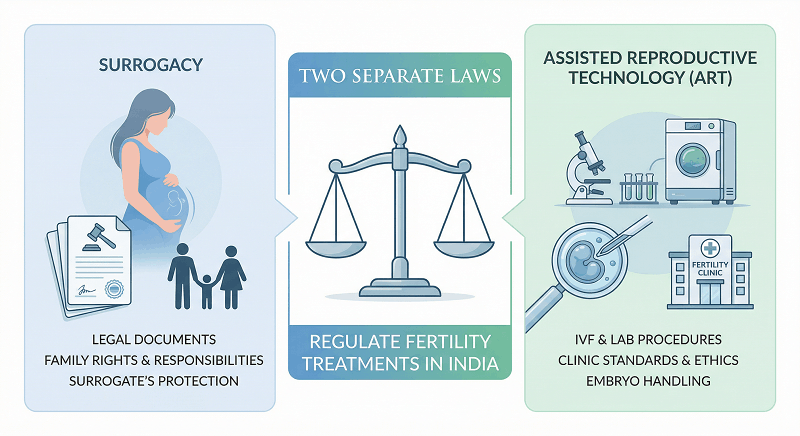
Both laws regulate different but interconnected aspects of reproductive medicine:
1. Surrogacy (Regulation) Act, 2021
This Act specifically governs:
- Who can opt for surrogacy
- Who can become a surrogate mother
- Legal documentation requirements
- Prohibition of commercial surrogacy
- Protection of surrogate rights
It ensures that surrogacy is conducted ethically and without financial exploitation.
2. Assisted Reproductive Technology (ART) Act, 2021
The ART Act regulates:
- IVF clinics
- Sperm banks
- Egg donation procedures
- Fertility laboratories
- Registration of ART clinics
It ensures that fertility centres follow standardized medical and ethical practices.
Together, these two laws:
- Prevent illegal fertility practices
- Protect surrogate mothers from exploitation
- Define eligibility for intended parents
- Establish legal parentage clarity
- Introduce penalties for violations
This dual regulation framework makes India’s surrogacy law one of the most structured in the world.
Types of Surrogacy Recognized in India

Under the Surrogacy (Regulation) Act, 2021, India legally permits only one specific form of surrogacy. The law intentionally narrows down the definition to prevent misuse, exploitation, and commercialization.
1. Altruistic Surrogacy (Only Legal Form in India)
Altruistic surrogacy is the only legally permitted type of surrogacy in India.
In this arrangement, the surrogate mother does not receive any financial compensation or payment for carrying the pregnancy. She agrees to help the intended couple purely out of compassion, emotional support, or family bonding.
However, the law allows reimbursement for:
- Full medical expenses related to IVF and pregnancy
- Hospitalization and delivery charges
- Insurance coverage for a specified period
- Pregnancy-related complications and medical needs
The purpose behind allowing only altruistic surrogacy is to:
- Prevent exploitation of economically vulnerable women
- Eliminate middlemen and commercial agents
- Ensure the surrogate’s decision is voluntary and not financially pressured
- Maintain the ethical and humanitarian nature of the process
Under the law, strict documentation and consent procedures are mandatory. The surrogate must:
- Provide written informed consent
- Undergo medical and psychological screening
- Be declared eligible by authorities
This system aims to balance reproductive rights with ethical safeguards.
2. Commercial Surrogacy (Strictly Banned in India)
Commercial surrogacy refers to an arrangement where the surrogate mother is paid a fixed amount beyond medical reimbursement for carrying the child.
Before regulation, commercial surrogacy was widely practiced in India. It turned the country into a global fertility destination. However, it led to several problems:
- Financial exploitation of poor women
- Unregulated fertility agencies
- Disputes over payment and custody
- Abandonment of children in rare cases
- International legal conflicts
Because of these concerns, the Surrogacy (Regulation) Act, 2021 completely banned commercial surrogacy.
Engaging in commercial surrogacy now results in:
- Heavy fines
- Imprisonment
- Cancellation of clinic licenses
The intention behind this ban is to remove the profit motive from childbirth arrangements and ensure dignity and protection for women.
Who Is Eligible for Surrogacy in India?

The Surrogacy Laws in India clearly define who can opt for surrogacy. The eligibility criteria are strict to prevent misuse and to ensure that surrogacy remains a last medical option, not a convenience choice.
Eligible Intended Parents
Under the law, the following categories are eligible:
1. Married Indian Heterosexual Couple
Only a legally married Indian man and woman can apply for surrogacy.
- Live-in partners are not eligible
- Same-sex couples are not eligible
- Single men are not eligible
- Foreign nationals are not eligible
The law prioritizes traditional marital arrangements under current legal structure.
2. Minimum Marriage Duration – 5 Years
The couple must have completed at least 5 years of marriage.
This requirement exists to:
- Ensure relationship stability
- Prevent impulsive surrogacy decisions
- Reduce legal complications related to divorce or separation
The government considers surrogacy a serious, long-term commitment that should not be pursued early in marriage without attempting other options.
3. Proven Infertility Certification
The couple must obtain a medical certificate of infertility from a District Medical Board.
Infertility may include:
- Inability to conceive naturally
- Recurrent pregnancy loss
- Medical conditions making pregnancy unsafe
- Absence of uterus or severe uterine disorder
This condition ensures that surrogacy is used as a medical necessity, not as a lifestyle preference.
4. Age Criteria
The law defines clear age limits:
- Wife: 23 to 50 years
- Husband: 26 to 55 years
These limits are set to:
- Ensure reproductive viability
- Protect child welfare
- Reduce medical risk factors
If either partner falls outside this age bracket, they are not eligible under current law.
5. No Surviving Child Rule
The couple must not have any surviving biological or adopted child.
However, there is an exception:
If the existing child suffers from:
- Life-threatening disorder
- Physical disability
- Mental disability
- Incurable disease
Then the couple may still be eligible for surrogacy.
This condition prevents the misuse of surrogacy for family expansion when a healthy child already exists.
Eligibility Criteria for Surrogate Mother in India
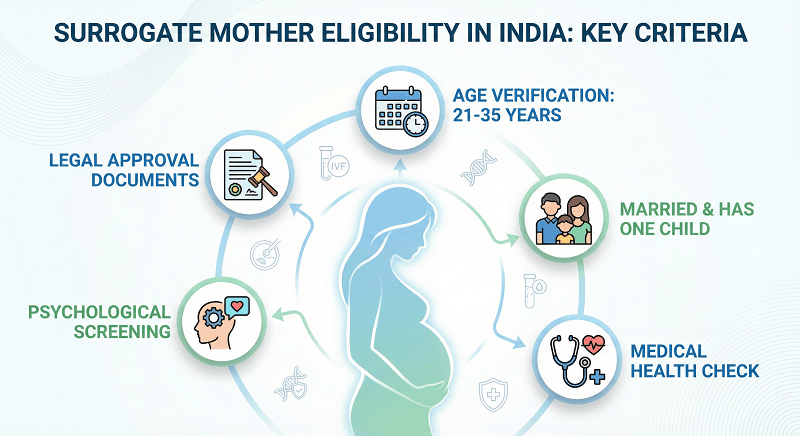
Under the Surrogacy (Regulation) Act, 2021, strict eligibility conditions have been defined for a woman to act as a surrogate mother. These provisions are designed to protect women from exploitation, reduce medical risks, and ensure that surrogacy remains ethical and regulated.
Not every woman can become a surrogate in India. The law clearly outlines specific requirements that must be fulfilled.
Let us examine each condition in detail.
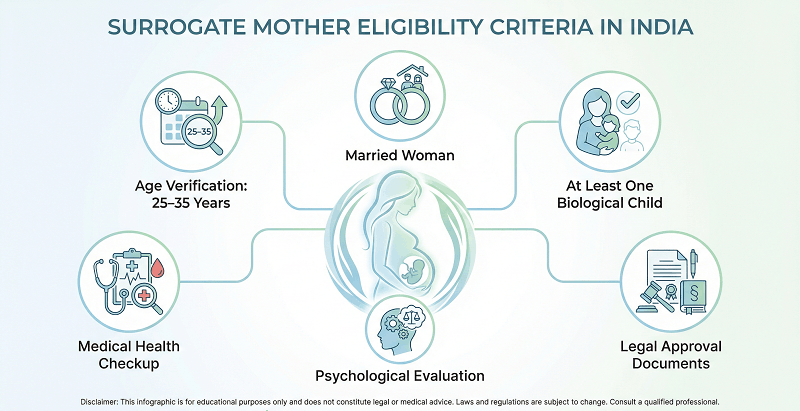
1. Must Be an Ever-Married Woman
The law requires that a surrogate mother must be an “ever-married” woman.
This means she must:
- Be currently married, or
- Have been married previously (including widow or divorcee)
The purpose of this condition is to ensure emotional maturity and social stability. A woman who has experienced marriage is considered more likely to understand the responsibilities and implications of pregnancy and childbirth.
This requirement also aims to reduce potential social and psychological complications.
2. Must Have at Least One Biological Child
A surrogate mother must have at least one biological child of her own.
This condition ensures:
- She has prior experience of pregnancy and childbirth
- She understands the physical and emotional aspects of motherhood
- The risk of post-delivery emotional attachment issues is reduced
The government included this rule to prevent emotional distress that may arise if a woman experiences pregnancy for the first time through surrogacy.
3. Age Requirement: 25 to 35 Years
The surrogate mother must be between 25 and 35 years of age.
This age bracket is medically considered the safest for pregnancy.
Women below 25 may not have complete emotional or physical maturity, while women above 35 may face higher risks such as:
- Gestational diabetes
- Hypertension
- Miscarriage
- Pregnancy-related complications
The age limit ensures both maternal safety and healthy pregnancy outcomes.
4. Can Act as Surrogate Only Once in Her Lifetime
The law clearly states that a woman can act as a surrogate only once in her lifetime.
This rule serves multiple purposes:
- Prevents repeated pregnancies for financial reasons
- Reduces health risks from multiple gestational cycles
- Ensures surrogacy does not become a commercial practice
This provision strengthens the ban on commercial surrogacy and protects women from becoming part of exploitative arrangements.
5. Mandatory Medical and Psychological Evaluation
Before approval, the surrogate mother must undergo:
- Complete medical screening
- Reproductive health tests
- Infectious disease screening
- Psychological evaluation
The medical assessment ensures she is physically fit for pregnancy.
The psychological evaluation ensures:
- She is making the decision voluntarily
- She understands the legal implications
- She is emotionally prepared for the process
These evaluations are conducted by registered fertility clinics or authorized medical boards.
6. Written Informed Consent Is Mandatory
The surrogate mother must provide written informed consent.
This consent confirms that:
- She understands the medical procedure
- She is aware of potential risks
- She agrees to carry the pregnancy voluntarily
- She will not claim parental rights over the child
The consent must be given freely without coercion, pressure, or financial inducement.
If proper consent documentation is not completed, the surrogacy arrangement may be considered invalid under the law.
Role of the Assisted Reproductive Technology (ART) Act in India
The Assisted Reproductive Technology (Regulation) Act, 2021 plays a crucial role in regulating fertility treatments across India. While the Surrogacy Act focuses specifically on surrogacy arrangements, the ART Act governs the broader ecosystem of assisted reproductive procedures such as:
- In Vitro Fertilization (IVF)
- Sperm donation
- Egg donation
- Embryo transfer
- Fertility preservation
Before this law was enacted, many fertility clinics operated under general medical guidelines without strict centralized regulation. This created inconsistencies in quality, ethical practices, and record maintenance. The ART Act was introduced to bring structure, accountability, and patient protection into the fertility industry.
1. Mandatory Registration of ART Clinics and Banks
One of the most important provisions of the ART Act is mandatory registration.
All ART clinics and ART banks must:
- Register with the appropriate authority
- Meet prescribed infrastructure standards
- Employ qualified medical professionals
- Maintain proper laboratory facilities
Unregistered clinics are not permitted to operate. This ensures that only authorized and verified institutions provide fertility services.
This step significantly reduces the risk of unqualified practitioners offering unsafe treatments.
2. Regulation of Sperm and Egg Donation
The Act strictly regulates gamete donation to prevent misuse and unethical practices.
Key rules include:
- Screening of sperm and egg donors
- Medical testing for infectious and genetic diseases
- Age limits for donors
- Controlled number of donations to prevent overuse
The law also restricts anonymity misuse and ensures proper documentation of donor identity in official records (while maintaining confidentiality).
This protects:
- The health of the child
- The rights of intended parents
- The dignity and safety of donors
3. Record Maintenance Requirements
ART clinics and banks are legally required to maintain detailed records of:
- Patient information
- Donor information
- Treatment procedures
- Embryo storage details
- Medical outcomes
These records must be preserved for a specified number of years as per regulations.
Proper documentation helps in:
- Preventing identity disputes
- Avoiding illegal embryo transfer
- Ensuring traceability in case of legal or medical issues
Failure to maintain records can lead to penalties and cancellation of registration.
4. Quality Standards for Laboratories
The ART Act mandates strict laboratory standards.
Clinics must ensure:
- Proper cryopreservation facilities
- Safe embryo handling procedures
- Hygienic and sterile lab conditions
- Use of approved medical technologies
This provision improves success rates and reduces medical complications.
High-quality lab standards are essential because ART procedures involve delicate processes such as embryo culture, fertilization, and transfer.
5. Strict Penalties for Non-Compliance
The Act includes strong punitive measures for violations.
Penalties may include:
- Heavy monetary fines
- Imprisonment
- Suspension or cancellation of clinic license
Any involvement in unethical practices such as:
- Unauthorized embryo transfer
- Sale of gametes
- Exploitation of donors
- Operating without registration
can result in severe legal consequences.
Legal Process of Surrogacy in India

Under the Surrogacy (Regulation) Act, 2021, surrogacy is not just a medical procedure — it is a legally supervised process. Every step must be approved by the appropriate authorities before the pregnancy can begin.
Failure to follow the legal process can result in penalties, cancellation of approval, or criminal liability.
Below is the complete step-by-step legal framework.
Step 1: Certificate of Essentiality
The first and most critical step is obtaining a Certificate of Essentiality.
This certificate is issued by the appropriate authority after verifying that surrogacy is medically necessary and legally justified.
To obtain this certificate, the intended parents must provide:
1. Medical Certificate of Infertility
A District Medical Board must certify that the couple suffers from proven infertility. This confirms that surrogacy is not being used for convenience but as a medical necessity.
Infertility may include:
- Failure to conceive despite medical treatment
- Recurrent miscarriages
- Absence of uterus
- Medical conditions that make pregnancy life-threatening
2. Magistrate’s Order Regarding Parentage
The intended parents must obtain a legal order from a Magistrate’s court declaring that the child born through surrogacy will legally belong to them.
This ensures:
- No custody disputes after birth
- Clear parental rights
- Legal recognition of intended parents
3. Insurance Coverage for Surrogate Mother
The couple must provide proof of insurance coverage for the surrogate mother for a specified period as prescribed under law.
This insurance covers:
- Pregnancy complications
- Post-delivery medical care
- Health risks arising from the surrogacy process
Only after verifying these documents does the authority issue the Certificate of Essentiality.
Step 2: Certificate of Eligibility
The next step is obtaining a Certificate of Eligibility.
This certificate confirms that the intended parents meet all legal conditions under the Act.
Authorities verify:
- Marriage duration (minimum 5 years)
- Age criteria (Wife: 23–50 years, Husband: 26–55 years)
- Indian citizenship
- No surviving healthy child (subject to exceptions)
- Medical necessity
Without this certificate, the surrogacy procedure cannot proceed.
This step ensures that only legally eligible couples can access surrogacy services.
Step 3: Surrogacy Agreement
Once both certificates are issued, a formal Surrogacy Agreement must be drafted and signed.
This is a legally binding contract between:
- Intended parents
- Surrogate mother
The agreement must comply strictly with statutory guidelines under the Surrogacy (Regulation) Act, 2021.
The agreement generally includes:
- Consent of the surrogate mother
- Declaration of no commercial compensation
- Coverage of medical expenses
- Insurance details
- Rights and responsibilities of both parties
- Commitment that the child will be handed over after birth
The surrogate must give written informed consent voluntarily.
This agreement protects:
- The surrogate mother
- The intended parents
- The legal status of the child
Step 4: Approval and Embryo Transfer
After completing legal documentation, the medical process may begin.
The embryo transfer can only be performed:
- In a registered ART clinic
- By authorized medical professionals
- After official approval
This process is regulated under the Assisted Reproductive Technology (Regulation) Act, 2021.
The clinic must:
- Maintain detailed medical records
- Follow laboratory quality standards
- Ensure safe embryo handling
- Comply with all legal reporting requirements
No clinic can legally perform embryo transfer without proper registration and documentation.
Rights of the Surrogate Mother in India
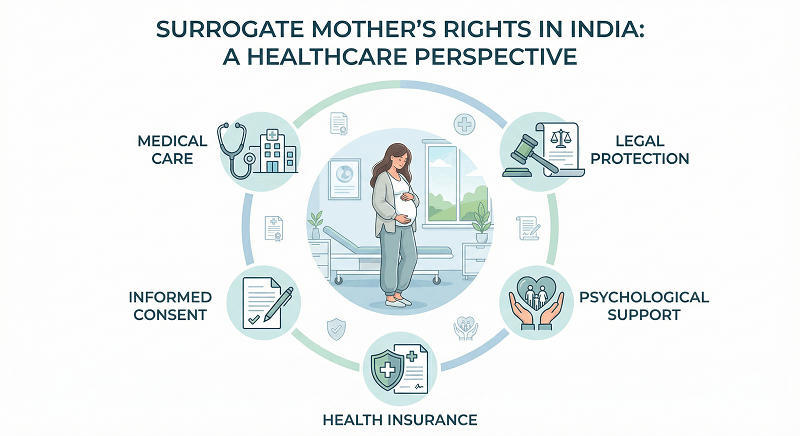
Under the Surrogacy (Regulation) Act, 2021, surrogate mothers are provided with strong legal protections. The law was specifically designed to safeguard women from exploitation and ensure that surrogacy remains ethical and humane.
A surrogate mother is not merely a participant in a medical procedure she is a legally protected individual with defined rights.
1. Right to Proper Medical Care and Counseling
The surrogate mother has the right to:
- Comprehensive medical screening
- Prenatal and postnatal care
- Psychological counseling before and during pregnancy
- Safe delivery in a registered medical facility
The intended parents are responsible for ensuring that all medical costs related to the pregnancy are covered.
Counseling is essential to ensure that the surrogate fully understands the physical, emotional, and legal implications of surrogacy.
2. Right to Withdraw Consent (Before Embryo Transfer)
The surrogate mother has the legal right to withdraw her consent at any time before embryo transfer.
This means:
- She cannot be forced to proceed
- She may reconsider her decision
- No legal action can be taken against her for withdrawal at this stage
However, once the embryo transfer is completed and pregnancy begins, the right to withdraw becomes legally restricted to protect the welfare of the unborn child and prevent disputes.
3. Right to Full Disclosure
The surrogate has the right to receive:
- Complete information about the medical procedure
- Details of risks and complications
- Legal terms of the surrogacy agreement
- Insurance and healthcare coverage details
Informed consent must be voluntary and free from coercion.
4. Right to Insurance Coverage
The law mandates insurance coverage for the surrogate mother for a specified duration.
This insurance must cover:
- Pregnancy-related complications
- Medical emergencies
- Post-delivery health issues arising from the surrogacy
This provision ensures financial protection and long-term security.
5. Protection from Exploitation
The Act strictly prohibits:
- Financial inducement
- Middlemen involvement
- Pressure from family or agencies
- Repeated surrogacy arrangements
These protections ensure that surrogacy remains altruistic and not a commercial activity.
Legal Status of the Child Born Through Surrogacy
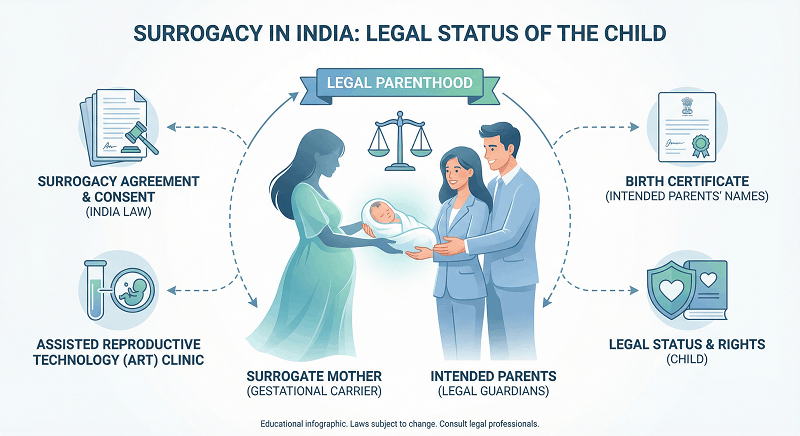
The Surrogacy (Regulation) Act, 2021 clearly defines the legal identity of the child born through lawful surrogacy.
1. Biological Child of Intended Parents
The child is legally considered the biological child of the intended parents from birth.
- Their names are entered on the birth certificate
- The surrogate mother’s name is not recorded as the legal mother
This removes ambiguity and prevents future custody disputes.
2. Full Legal Rights
The child is entitled to:
- Inheritance rights
- Citizenship rights
- Maintenance and guardianship
- All constitutional protections
The child is treated exactly like a naturally born child of the couple.
3. No Parental Rights of Surrogate Mother
Once the child is born, the surrogate mother has:
- No custody rights
- No guardianship claims
- No parental authority
This legal clarity protects all parties involved.
Prohibited Practices Under Surrogacy Law
The Surrogacy Act strictly prohibits several practices to maintain ethical standards.
1. Commercial Surrogacy
Any form of payment beyond medical reimbursement is illegal.
2. Advertising Surrogacy Services
Promoting surrogacy for commercial gain is prohibited.
3. Sex Selection
Sex selection before or after embryo transfer is banned under Indian law.
4. Exploitation of Surrogate Mothers
Coercion, emotional pressure, or financial manipulation is punishable.
5. Abandonment of Child
Intended parents cannot abandon a child born through surrogacy, including in cases of disability.
6. Importing Human Embryos
The import of embryos for surrogacy purposes is not permitted.
Violation of these provisions may lead to imprisonment of up to 10 years and heavy fines.
Challenges and Criticism
Despite strong protection, some experts argue:
- Strict eligibility excludes many couples
- Single women and LGBTQ individuals are excluded
- Long documentation process delays treatment
- Limited surrogate availability
However, policymakers prioritize regulation over liberalization.
Documentation Required for Legal Surrogacy
- Marriage certificate
- Medical infertility certificate
- Age proof
- Identity proof
- Insurance documents
- Magistrate order
- Surrogate consent
Incomplete documentation can delay approvals.
Role of Appropriate Authority
Each state appoints an appropriate authority responsible for:
- Granting approvals
- Monitoring clinics
- Investigating complaints
- Cancelling registration of violators
This decentralised system ensures better compliance monitoring.
Conclusion
Surrogacy Laws in India represent a major shift toward ethical, transparent, and regulated fertility treatment. The enactment of the Surrogacy (Regulation) Act, 2021 and the Assisted Reproductive Technology Act ensures protection for surrogate mothers, intended parents, and children born through surrogacy.
While the law imposes strict eligibility criteria and bans commercial surrogacy, its primary aim is to prevent exploitation and maintain dignity in reproductive arrangements. Couples considering surrogacy must carefully understand legal requirements, consult registered clinics, and ensure complete documentation before proceeding.
Surrogacy in India is no longer a commercial industry but a legally protected medical pathway designed to balance hope for parenthood with ethical responsibility.
Frequently Asked Questions (FAQs)
Below are detailed and practical FAQs to help intended parents clearly understand Surrogacy Laws in India under the Surrogacy (Regulation) Act, 2021 and the Assisted Reproductive Technology (Regulation) Act, 2021.
Yes, surrogacy is legal in India, but only altruistic surrogacy is permitted. Commercial surrogacy, where a surrogate mother is paid beyond medical and insurance expenses, is strictly prohibited under current law.
Altruistic surrogacy means the surrogate mother does not receive financial compensation except for medical expenses, insurance coverage, and pregnancy-related costs. Any additional monetary benefit is illegal.
Under Surrogacy Laws in India, only a legally married Indian heterosexual couple can apply, provided:
– They have been married for at least five years
– They have proven medical infertility
– They meet the age criteria (wife: 23–50 years, husband: 26–55 years)
– They do not have a surviving biological or adopted child (with limited medical exceptions)
Currently, single men are not eligible. The law has limited provisions for certain categories of women, but in general, surrogacy is restricted mainly to married Indian couples.
No. Foreign nationals are not permitted to opt for surrogacy in India under current regulations. This restriction was introduced to prevent exploitation and legal complications.
A surrogate mother must:
– Be an ever-married woman
– Have at least one biological child
– Be between 25–35 years of age
– Act as a surrogate only once in her lifetime
– Pass medical and psychological screening
She must also give written informed consent.
Yes, a surrogate mother can withdraw her consent before embryo transfer. However, once embryo transfer has taken place, withdrawal rights become legally restricted.
The documentation generally includes:
– Marriage certificate
– Medical infertility certificate
– Age proof and identity proof
– Surrogate consent form
– Insurance policy for surrogate
– Court or magistrate order confirming parentage
Engaging in commercial surrogacy or running an unregistered clinic may lead to:
– Imprisonment up to 10 years
– Fine up to ₹10 lakh
Strict penalties are designed to prevent exploitation and unethical practices.
Yes. The intended parents must provide insurance coverage for the surrogate mother for 36 months to cover medical complications and postpartum care.
Read Also:
- Surrogacy Cost in Kolkata (2026) – Complete Price Breakdown & Legal Guide
- Best Surrogacy Centre in Delhi (2026 Guide for Intended Parents)
- Surrogacy Legal Countries 2026 – Where Surrogacy Is Allowed Worldwide
- Best Surrogacy Centre in Lucknow (2026 Trusted & Legal Guide)
- Best Surrogacy Centre in Bangalore 2026 Guide for Intended Parents

Medically Reviewed By: Select Surrogacy India Medical Team (Fertility Experts & IVF Specialists)
Our content is reviewed by experienced fertility specialists and IVF professionals associated with Select Surrogacy India, ensuring accurate, up-to-date, and reliable information for intended parents.
✔ IVF Treatment Guidance✔ Surrogacy Consultation✔ Egg Donation Support
👉 Content reviewed for accuracy and latest IVF & surrogacy laws in India