Okay so for the past few months, every fertility forum and Facebook group I’ve been scrolling through has had the same recurring theme — people are genuinely confused about ivf cost in australia and have no idea how to actually budget for it. Some people think IVF means one shot at $30,000, some think Medicare covers everything, and some don’t even know that a couple of states offer free public IVF. So I figured, let’s break this down properly, with real numbers, no sugar-coating.
In this article, we’ll cover what ivf cost in australia actually looks like, how Medicare and the PBS bring the cost down, how much add-ons like ICSI and genetic testing pile on top, public vs private options, state-by-state differences, and all the stuff no clinic tells you on your first phone call. Grab a coffee (or a flat white, since we’re talking about Australia here) and settle in, because this is going to be a long but genuinely useful read.

Let’s Start With the Basics — How Is IVF Cost Actually Calculated?
The first thing to understand — ivf cost in australia isn’t a fixed number. It depends on which clinic you choose, which city or state you’re in, what specific treatment you need (just standard IVF or something with ICSI and PGT add-ons), and most importantly, how Medicare rebates and private health insurance factor into your particular case.
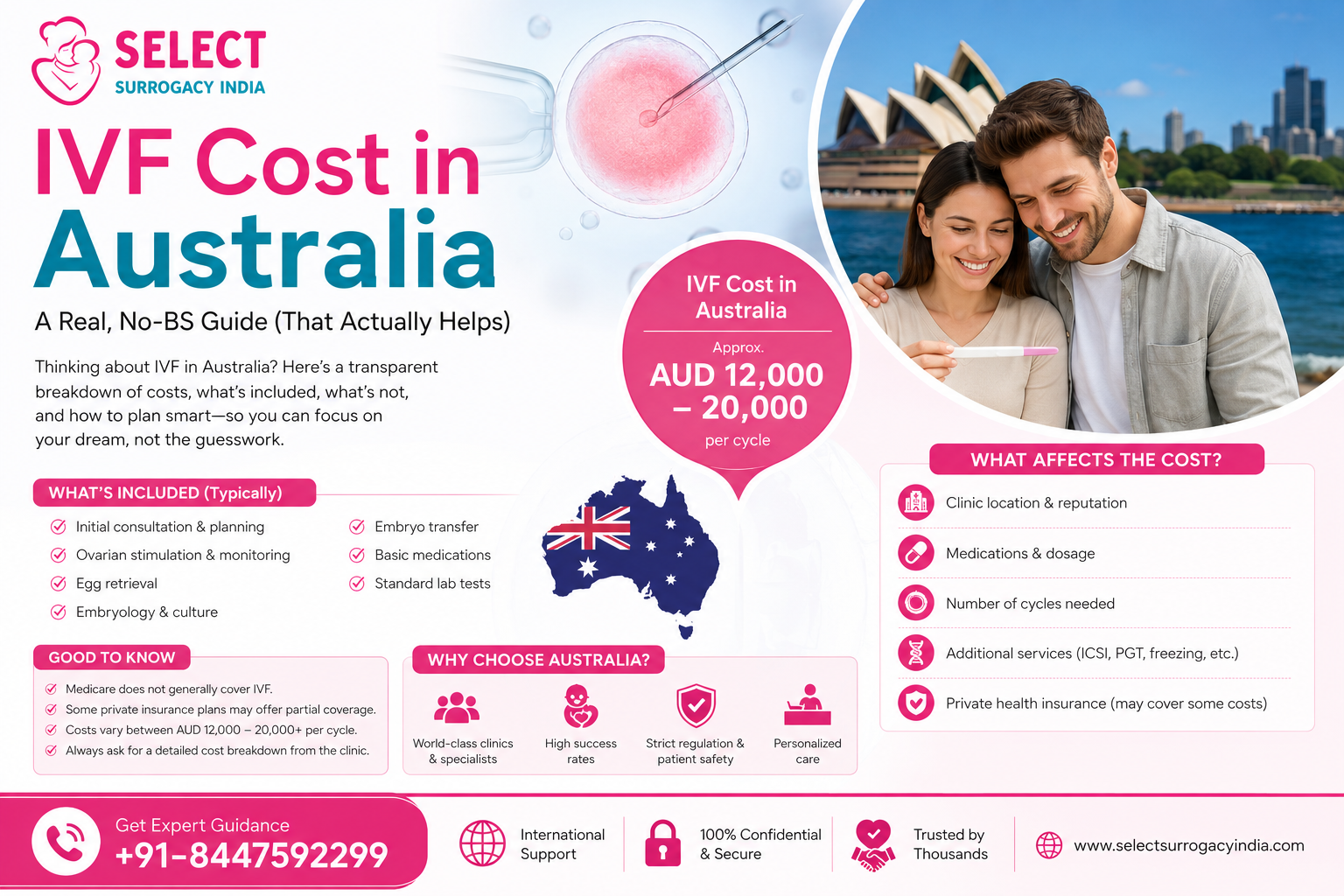
Based on general industry data, a standard IVF cycle in Australia typically costs between $8,000 and $15,000 before the Medicare rebate. This is the “before rebate” figure, meaning it’s the amount the clinic actually charges for the whole treatment — consultations, monitoring, egg retrieval, lab work, and embryo transfer all combined. So whenever someone discusses ivf cost in australia, it’s important to clarify upfront whether they’re talking about the “gross cost” or the “out-of-pocket” cost, because the difference between the two is significant.
After Medicare rebates, the actual out-of-pocket amount usually comes down to somewhere between $4,500 and $10,000 per cycle, depending on the clinic and the individual case. Some bulk-billing clinics like Adora Fertility can bring this down to as low as $0 to $700 out-of-pocket, which is a genuine game-changer for people working with a tight budget.
How Medicare Works for IVF
This is the part where understanding ivf cost in australia becomes really important, because Australia is one of a handful of countries where Medicare partially covers fertility treatment — something that isn’t standard even in many developed countries like the UK.
Medicare provides rebates for specialist consultations, monitoring ultrasounds, egg retrieval, embryo transfer, and frozen embryo transfer (FET) through specific MBS (Medicare Benefits Schedule) item numbers. This means when you pay the doctor’s fees, a portion of it comes back to you from Medicare — usually 85% of the MBS schedule fee for out-of-hospital specialist services.
The best part is that there’s no lifetime limit on Medicare-funded cycles — meaning you can go through as many IVF cycles as you need, and the Medicare rebate still applies, with no cap whatsoever. This is a massive relief for couples who end up needing multiple cycles, which honestly happens more often than people expect.
There’s also something called the Medicare Safety Net. Once your annual out-of-pocket medical expenses cross a certain threshold (which changes slightly year to year, generally sitting somewhere between $800 and $2,500), Medicare starts paying 80% of the gap fees for the rest of that calendar year. So if you’re doing multiple cycles within the same calendar year, the ivf cost in australia for your second or third cycle can end up noticeably lower than the first one, because the Safety Net kicks in.
The PBS and Fertility Medication Costs
Another thing people often forget to factor into their ivf cost in australia calculations is the cost of medications. The IVF process involves hormonal injections for ovarian stimulation, which can actually get quite expensive if paid at full private price — typically $1,500 to $3,500 per cycle.
This is where the PBS (Pharmaceutical Benefits Scheme) comes in. When these medications are prescribed by a fertility specialist under specific Authority items, they become heavily subsidised — the cost for general patients usually comes down to just $125 to $285 per cycle, which is dramatically lower than the full price. For concession card holders, it’s even lower.
There’s also a separate PBS Safety Net, which applies specifically to medications — once your annual medication spend crosses a threshold, medications for the rest of the year become even cheaper, almost negligible for general patients.
Extra Add-Ons That Can Increase the Total Cost
Now here’s the part that probably causes the most confusion — add-on procedures. These are things that aren’t included in the standard IVF package, and vary from clinic to clinic:
ICSI (Intracytoplasmic Sperm Injection) — When sperm count or motility is low, or a previous IVF cycle had fertilization failure, doctors recommend ICSI, where a single sperm is injected directly into the egg. This typically adds $1,000 to $2,500 on top of the base IVF cost.
PGT (Preimplantation Genetic Testing) — If you want to genetically test embryos (to check for chromosomal abnormalities), this isn’t Medicare-rebated. PGT-A, PGT-M, or PGT-SR tests cost around $600 per embryo, plus separate base testing fees. This can add a significant chunk to your overall ivf cost in australia, especially if you have multiple embryos to test.
Embryo and Sperm Freezing — If you want to freeze embryos or sperm for future use, embryo freezing costs around $625 for six months of storage, and sperm freezing around $475 for six months. Long-term storage attracts separate annual fees.
Day Hospital and Anaesthetist Fees — Procedures like egg retrieval require day surgery and sedation, which aren’t fully covered by Medicare. If you have private health insurance, this might be partially covered, but if not, it becomes an additional out-of-pocket expense.
Add all these up, and ivf cost in australia can easily double if the case is complex and multiple interventions are needed.
Bulk-Billing and Low-Cost Clinics — An Underrated Option
Not many people know that Australia has a few clinics that specifically operate on a low-cost or bulk-billing model, which can dramatically lower ivf cost in australia for those who qualify.
Take Adora Fertility, for example, which offers a bulk-billing option where out-of-pocket costs can sometimes stay as low as $0 to $700. Similarly, The Fertility Centre (operating in Sydney, Penrith, Brisbane, and the Gold Coast) can bring the out-of-pocket cost of an IVF cycle down to around $6,000 or even less through its “affordable IVF” model, depending on individual treatment needs and health fund coverage. Some states also have additional schemes, like a NSW $2,000 IVF rebate, which lower costs further for eligible patients.
These options are especially helpful for couples who don’t have premium private health insurance, or who can’t afford the financial burden of multiple cycles. So when researching your own budget, don’t just stick to the big-name premium clinics — it’s worth exploring bulk-billing options too.
Public Hospital IVF — Is It Actually Free?
This is something that doesn’t get discussed much, but is genuinely a game-changer — some Australian states offer free or heavily subsidised IVF through public hospitals. Currently, states like NSW, Victoria, and Queensland have public programs where eligible patients can get significantly reduced or zero-cost IVF.
But, as with anything good, there are trade-offs. Wait times typically range from 6 to 24 months, which can be pretty frustrating for couples dealing with time-sensitive concerns (like age-related fertility issues). Also, only 3 out of 8 states/territories currently have some form of this available, meaning if you live elsewhere, this option simply won’t apply.
So when planning your own budget, it’s worth checking whether your state has any public program available, and if so, whether the wait time is actually feasible for your situation.
State-by-State Cost Comparison — Does Location Really Matter?
Yes, honestly, location makes a real difference. Capital city pricing generally runs 15% to 25% higher than regional areas, since clinic overheads, rent, and specialist fees are all higher in the city.
For example, in NSW, providers like IVF Australia publish detailed cost tables that break down each item. In Victoria, Melbourne IVF; in Queensland, Queensland Fertility Group; and in Tasmania, TasIVF operate as sister clinics under the same Virtus Health network, though their exact pricing can vary slightly based on state-specific factors.
So if you’re flexible about location, considering regional clinics can be a smart move to bring down your ivf cost in australia, as long as the clinic is RTAC-accredited and quality isn’t compromised.
The Real Cost of Multiple Cycles
This is genuinely important to understand, because success on a single cycle isn’t guaranteed. Industry data suggests that on average, 2 to 3 cycles are needed for a successful pregnancy, depending on age, underlying fertility issues, and individual response to treatment.
This means that if you’re planning your budget based on just one cycle’s ivf cost in australia, you’re likely underestimating your actual financial commitment. Realistically, total costs across 2-3 cycles can run $15,000 to $25,000, and while later cycles can be somewhat cheaper once the Medicare Safety Net threshold is crossed, the overall amount is still significant.
So when doing your financial planning, it’s worth thinking through a “worst-case scenario” — that if the first cycle doesn’t work, you’ll have the budget in place for a second and third attempt too.
The Role of Private Health Insurance
A lot of people assume that having private health insurance means ivf cost in australia gets fully covered — but that’s not entirely accurate. Private health insurance usually covers hospital-related costs, like day surgery, anaesthetist fees, and hospital accommodation, but the professional and lab fees for IVF (like embryology, monitoring, medication) usually aren’t covered by insurance.
So it’s important to speak directly to your insurance provider before starting treatment and confirm exactly what’s covered and what isn’t. A lot of couples mistakenly believe having insurance means zero out-of-pocket cost, when in reality it only covers a portion, not the whole thing.
Depending on your policy, higher-tier hospital cover plans might offer slightly better coverage compared to basic plans, so if you’re actively planning a family, upgrading your policy could be a smart financial move to reduce the future burden of ivf cost in australia.
Comparison — IVF vs ICSI vs Egg Freezing Cost
Let’s do a quick comparison to give you a clearer picture of what different procedures roughly cost:
Standard IVF — $8,000-$15,000 gross, $4,500-$10,000 out-of-pocket after Medicare rebate.
ICSI — Standard IVF cost plus an additional $1,000-$2,500.
Egg Freezing — The retrieval and freezing process costs about the same as standard IVF, plus separate annual storage fees, which are similar to embryo storage fees.
PGT Testing — $600 per embryo, plus a base lab testing fee, none of which is Medicare-rebated.
Frozen Embryo Transfer (FET) — This is considerably cheaper than a fresh IVF cycle, since there’s no egg retrieval involved — it’s simply transferring a previously frozen embryo. This is useful when extra embryos remain frozen from an earlier cycle.
This comparison makes it clear that ivf cost in australia depends heavily on which specific procedures you actually need, rather than there being one fixed “IVF price.”
Major IVF Clinic Providers in Australia — Who’s Who
Let’s take a deeper look at the major players in the Australian fertility market, because until you know what options exist, comparing your own expenses realistically becomes difficult.
Virtus Health Network — Australia’s largest fertility network, including IVF Australia (NSW), Melbourne IVF (VIC), Queensland Fertility Group (QLD), and TasIVF (Tasmania). They operate at premium-tier pricing, generally with a full-service, research-backed approach, and their fees usually sit at the higher end of the market.
Monash IVF — Another well-established national provider present across multiple states. They offer different pricing tiers, including some “value” packages for patients looking for a lower-cost option.
Genea — Sydney-based, with multiple locations, Genea is known for its advanced embryology labs. Their pricing generally falls in the mid-to-premium range.
City Fertility — Another national provider offering different price points, present in several cities.
Adora Fertility and The Fertility Centre — As discussed earlier, these specifically focus on a low-cost and bulk-billing model, best suited for those who want to keep their out-of-pocket spend to a minimum, without major compromise on quality.
Each provider has its own approach, lab technology, and specialist team, so basing your decision purely on price isn’t ideal — success rates, reviews, and personal comfort level matter just as much.
How Does Age Affect the Cost?
This is a factor that doesn’t directly set the price, but indirectly influences your overall treatment expenses significantly. The older you get, especially past 35, the lower the per-cycle success rate tends to be, which means you might need more cycles overall to succeed.
Past 40, some clinics also recommend additional genetic screening or donor egg options, which add extra cost on their own. So starting treatment at a younger age isn’t just medically smarter, it’s financially smarter too, since fewer cycles are typically needed for success, which naturally keeps overall ivf cost in australia lower.
Doctors generally advise that if you’re facing fertility issues, consulting a specialist as early as possible is important, because delaying doesn’t just carry an emotional cost — it can increase the financial cost too, in the long run.
Donor Eggs, Sperm, and Embryos — What Do They Cost?
In some cases, whether due to age-related infertility or a medical condition, couples need donor gametes. This is an area that follows a quite different pricing structure from standard IVF.
Donor Sperm — Sourcing donor sperm from a sperm bank typically costs per vial, with the base IVF or IUI cost added separately.
Donor Eggs — This is the most expensive option, since it includes the egg donor’s own medical screening, stimulation cycle, and retrieval costs, making the overall package significantly more costly than standard IVF.
Donor Embryos — Some clinics also offer donated embryos from couples who have extra frozen embryos and choose to donate them. This is usually the most affordable donor option, since it doesn’t require a fresh stimulation cycle.
Australia also has specific legal and ethical guidelines around donor gametes — for instance, donor anonymity isn’t allowed, and the child has the right to access donor information after turning 18. So if you’re considering this route, it’s important to have a detailed conversation with your clinic about these legal aspects alongside the cost.

A Typical IVF Cycle’s Cost Timeline
Let’s look at a practical timeline of when the money actually gets spent throughout a cycle, so you get a real sense of budgeting in real time:
Week 1-2 — Initial Consultation and Testing — This includes specialist consultation fees, blood tests, and baseline ultrasounds. This is usually a small portion of the overall package, but essential for an accurate diagnosis.
Week 2-3 — Ovarian Stimulation — This is the phase where medication cost matters the most, plus the cost of regular monitoring appointments.
Week 3 — Egg Retrieval — This includes day hospital fees, anaesthetist charges, and the retrieval procedure itself, forming a significant chunk of the overall cycle.
Week 3-4 — Fertilization and Embryo Culture — Lab fees apply at this stage, and if ICSI is being used, that additional cost gets added here too.
Week 4 — Embryo Transfer — A relatively simpler and less expensive procedure, though specialist and clinic fees are still involved.
Week 6 — Pregnancy Test and Follow-up — The final stage, where it’s confirmed whether the cycle was successful or not.
Understanding this timeline is helpful because you can plan in advance how much cash flow you’ll need at each stage, rather than needing to arrange the whole amount at once.
Practical Tips to Reduce the Cost
Let’s talk about some actionable tips that can genuinely help you manage ivf cost in australia:
Get Multiple Quotes — Don’t decide based on just one clinic’s quote. According to data from platforms like Compare IVF, comparing at least three quotes can save an average of 18%, compared to accepting the first offer.
Ask for an Itemised Quote — Flat-rate quotes can sometimes hide exclusions. Always ask for a detailed, itemised breakdown, so no hidden costs come as a surprise.
Explore Public Options — If your state has a public hospital IVF program, don’t hesitate to apply, even if the wait time is a bit longer.
Check Bulk-Billing Clinics — As discussed above, some clinics offer dramatically lower out-of-pocket costs, which is genuinely worth exploring.
Take Advantage of the Medicare Safety Net — If you know you’ll need multiple cycles, it’s worth strategically timing them so you cross the Safety Net threshold sooner, making later cycles cheaper.
Confirm PBS Authority Items — Make sure your specialist is prescribing medications under the correct PBS Authority items, so you get the subsidised rate rather than full private pricing.
Ask About Financial Assistance Packages — Some clinics (like The Fertility Centre) offer financial assistance packages for eligible patients, which you’ll usually only find out about by directly asking, since they’re not always advertised on the website.
A Sample Budget Checklist — Before You Start
If you’re actually building your own budget around ivf cost in australia, here’s a practical checklist to cover:
- Specialist consultation fees (initial and follow-up)
- Diagnostic tests and blood work
- Base IVF cycle fee (varies by clinic)
- Medication costs (with a PBS-subsidised estimate)
- Day hospital and anaesthetist fees
- ICSI (if recommended)
- Embryo/sperm freezing and storage (if applicable)
- PGT genetic testing (if you’re considering it)
- Frozen Embryo Transfer costs (if extra embryos remain from the first cycle)
- Counseling or emotional support services
- Travel and accommodation (if you live regionally and need to visit a city clinic)
- A buffer amount for a second or third cycle
Cross-check this list against your specific clinic’s itemised quote, so you know exactly how each item contributes to your total ivf cost in australia budget, and nothing gets missed.
What Interstate and Regional Patients Should Consider
In a country as vast as Australia, many patients live in regional or remote areas without access to a dedicated fertility clinic nearby. In that case, treatment often means travelling to a city, adding an extra layer of cost and logistics — flights or driving, accommodation, and time off work.
Some clinics now offer telehealth consultations for initial appointments, meaning patients don’t need to travel physically every single time — only for monitoring and procedures that require a city visit. This is a practical solution that reduces overall hassle, and sometimes total expenses too, since travel trips get minimised.
If you live regionally, it’s worth asking your clinic whether they offer a telehealth or hybrid model, and whether they have any local partnerships that reduce how often you need to travel to the city. It sounds like a small thing, but practically, it can save time, energy, and money all at once.
Additionally, if you want to seek treatment in a different state (say, because your home state has a longer wait time), that’s also a valid option — just keep in mind that Medicare rebates are processed based on the treating state rather than your home state, and travel-related costs need to be factored into your budget separately.
The Connection Between Success Rates and Cost
Something people often overlook is the relationship between success rates and cost. Every clinic publishes its success rates, usually broken down by age group, and these numbers directly impact how many cycles you might need.
Sometimes a slightly more expensive clinic with a higher success rate can actually work out cheaper in the long run, because you might succeed in fewer cycles — whereas a cheaper clinic with a lower success rate might mean multiple cycles, ultimately increasing total expenses.
So comparing per-cycle price alone isn’t enough — you should always look at a clinic’s published success rates, especially data specific to your own age group. All RTAC-accredited clinics in Australia report their data through the Fertility Society of Australia and New Zealand (FSANZ), which ensures transparency. This data is publicly available and worth checking before making a decision.
You should also directly ask your doctor what a realistic success rate looks like for your specific case type (based on your age, diagnosis, and medical history), rather than relying on generic clinic-wide averages. This should be a personalised conversation, not just trust in brochure numbers.
How to Tell if a Clinic Is Genuinely Trustworthy
With this much financial and emotional commitment involved, it’s important to recognise a few red flags and green flags when choosing a clinic:
Green Flags:
- The clinic is RTAC (Reproductive Technology Accreditation Committee) accredited
- Success rates are reported to FSANZ and are publicly verifiable
- You get itemised, transparent quotes with no hidden charges
- Counseling and emotional support services are available
- The doctor patiently answers all your questions
Red Flags:
- The clinic makes unrealistic promises like “guaranteed pregnancy”
- You get vague or evasive answers about pricing
- No proper accreditation or certification is shown
- Reviews repeatedly mention hidden charges
- Consultations feel rushed, with no time given for your questions
Following this checklist protects not just your money, but also your emotional peace of mind, which matters just as much as financial planning throughout this journey.
Emotional and Financial Planning Go Hand in Hand
When we only talk about numbers and the ivf cost in australia breakdown, we sometimes forget how much emotional journey is tied to it. Every cycle comes with hope, some stress, and if the result is negative, disappointment too. So while planning your finances, emotional wellbeing deserves just as much priority.
Many couples also opt for counseling alongside treatment, which a lot of clinics include in their package or offer separately. This is a good practice, since fertility treatment affects the mind just as much as the body. So when budgeting, it’s smart to leave a little buffer for counseling or support services too.
Common Myths People Believe About IVF Cost
Let’s do some myth-busting:
Myth 1: “Medicare makes everything free” — Completely wrong. Medicare only covers a portion, not the whole thing. A significant chunk of ivf cost in australia always remains out-of-pocket, no matter how much rebate you get.
Myth 2: “Every clinic charges the same price” — No, pricing varies quite a bit from clinic to clinic and state to state. That’s why getting multiple quotes is always a smart move.
Myth 3: “Private insurance covers all of IVF” — As discussed above, insurance usually only covers hospital-related costs, not professional and lab fees.
Myth 4: “Success is guaranteed in just one cycle” — In reality, an average of 2-3 cycles are needed, so budget planning should reflect that.
Myth 5: “Public IVF options don’t exist” — This is false. Some states genuinely have free or heavily subsidised public IVF programs, though wait times can be longer.
Insurance Add-Ons and Why Comparing Health Funds Matters
Australia’s health insurance landscape is pretty fragmented — there are dozens of health funds, each with their own tiers, waiting periods, and exclusions. So when planning fertility treatment, carefully reviewing your current policy is essential, since a lot of basic or mid-tier hospital policies explicitly exclude fertility-related procedures, or impose a 12-month waiting period on them.
If you’re not planning treatment right now but are considering family planning in the future, checking your policy now is a smart move, since waiting periods mean a last-minute upgrade won’t help. Some funds specifically offer “Gold” tier policies that include assisted reproductive services like IVF, while “Silver” or “Bronze” tiers might exclude it.
Using comparison websites and resources like the government’s Private Health Insurance Ombudsman website, you can find the right policy for your specific needs. This can feel like a time-consuming process, but if you know you’ll need fertility treatment, doing this research beforehand can significantly reduce the financial stress once treatment begins.
Some employers are now also including fertility benefits in their employee wellness packages, especially larger corporates. So it’s worth checking with your HR team whether your company offers such a benefit, which could directly or indirectly help with your treatment expenses.
A Real-World-Ish Scenario — To Help It Sink In
Let’s make this a bit more relatable with a hypothetical scenario (not a real individual, just an illustrative example). Say there’s a couple, both 33, who’ve been trying to conceive naturally for the past two years and decide to consult a specialist.
Their initial consultation and testing costs a few hundred dollars. The doctor recommends standard IVF, since the male partner’s sperm count is normal, so ICSI isn’t immediately necessary. Their first cycle’s base fee comes to around $10,000, of which Medicare rebates approximately $3,000, and PBS-subsidised medication costs around $200. Their final out-of-pocket for the first cycle sits around $6,500-$7,000.
Unfortunately, the first cycle isn’t successful. For the second cycle, since their annual out-of-pocket expenses have already crossed the Medicare Safety Net threshold, they get some additional rebate, making the net cost of the second cycle somewhat lower. The second cycle results in a confirmed pregnancy.
All up, the combined out-of-pocket cost for both cycles comes to roughly $12,000-$13,000 — which is realistic given the typical range we discussed earlier. This example is shared to give you a concrete sense of how the numbers actually play out in practice, rather than just abstract ranges.
Tax and Record-Keeping — Small Things That Add Up
While this isn’t the most exciting part of the process, keeping thorough records of every fertility-related expense is genuinely worth doing. Receipts for consultations, medications, hospital fees, and even travel costs related to treatment can matter later, whether for insurance claims, workplace reimbursement programs, or simply keeping your own finances organised across multiple cycles.
It’s also worth checking with your accountant or a tax professional about whether any portion of your medical expenses might be relevant come tax time, since rules around medical expense claims can shift and vary depending on your individual circumstances. This isn’t something to assume blindly — it’s genuinely worth a quick, personalised conversation with someone qualified, rather than going off general internet advice.
Keeping a simple spreadsheet that tracks every payment — the date, the clinic, what it was for, and whether Medicare or insurance reimbursed any part of it — can make a real difference when you’re trying to understand your actual running total partway through treatment, rather than being surprised at the end.
Questions Worth Asking at Your First Consultation
Walking into your first fertility consultation can feel overwhelming, especially if you’re not sure what to ask. Here’s a short list of cost-related questions that are worth raising early on, so there are no surprises later:
- What’s the total estimated cost for a single cycle, including medications?
- Which specific items are Medicare-rebatable, and which aren’t?
- Is ICSI likely to be needed in my case, and if so, what does that add to the cost?
- What are the embryo and sperm storage fees, and how often are they billed?
- Does the clinic offer any financial assistance packages or payment plans?
- What happens cost-wise if the first cycle isn’t successful — is there a discount on subsequent cycles?
- Are there any additional fees not included in the standard quote (admin fees, cancellation fees, etc.)?
Asking these questions upfront, ideally in writing so you have something to refer back to, puts you in a much stronger position to actually plan your finances rather than discovering extra costs mid-treatment.
Is It Worth the Investment?
This is a question that can’t be answered by numbers alone. Ivf cost in australia is definitely a significant financial commitment, but for couples who genuinely want to become parents, it’s an investment that’s emotionally priceless. Financial planning is necessary, but making a decision purely based on cost isn’t right either — your personal circumstances, medical advice, and emotional readiness all need to be factored in.
The good news is that thanks to Medicare, the PBS, and public hospital options within Australia’s healthcare system, ivf cost in australia ends up being far more accessible than in many other countries. So if you move forward with proper research and planning, it can be financially manageable, especially when you take full advantage of all available rebates and subsidies.

So, Finally — How Much Does IVF Cost in Australia?
If I had to sum it all up simply, ivf cost in australia looks something like this — a standard cycle’s gross cost sits between $8,000 and $15,000, which comes down to $4,500-$10,000 out-of-pocket after Medicare rebates. Bulk-billing clinics can bring that down to $0-$700, and in some states, public hospital programs can make it almost free, with a longer wait. Add-ons like ICSI, PGT testing, and embryo/sperm freezing pile extra onto this base cost, and if you need multiple cycles (which is fairly common), total costs can run $15,000 to $25,000.
Bottom line — ivf cost in australia isn’t a fixed number, it completely depends on your individual case, location, clinic choice, and available rebates. So the most important thing is to do thorough research, compare multiple quotes, and have a completely transparent conversation with your specialist about costs, so nothing catches you off guard once treatment begins.
Frequently Asked Questions (FAQs)
A standard IVF cycle’s gross cost typically ranges from $8,000-$15,000, which comes down to $4,500-$10,000 out-of-pocket after the Medicare rebate.
No, Medicare only covers a portion — specialist consultations, monitoring, egg retrieval, embryo transfer, and similar items. Medications, day surgery, and genetic testing need to be paid separately, though partially covered by insurance in some cases.
Yes, some states like NSW, Victoria, and Queensland offer free or heavily subsidised IVF through public hospital programs, though wait times can be 6-24 months.
ICSI typically adds $1,000-$2,500 to the base IVF cost, depending on the clinic.
No, there’s no lifetime limit on Medicare-funded cycles.
PGT testing usually costs around $600 per embryo, plus a base lab testing fee, and it’s not Medicare-rebated.
Insurance usually only covers hospital-related costs (day surgery, anaesthetist), not the professional and lab fees for IVF. So you shouldn’t expect the full cost to be covered.
On average, 2-3 cycles are needed, so when planning your total cost, you should factor in multiple cycles rather than just one.
Yes, donor sperm is relatively affordable, but donor eggs can be significantly more expensive since they include the egg donor’s own stimulation and retrieval costs. Donor embryos are usually the most affordable donor route.
Yes, regional patients may face additional costs like travel and accommodation, though some clinics offer telehealth consultations to help reduce these expenses.
Read Also:-
- IVF Cost in Ajman – Affordable & Transparent Treatment Options
- Best IVF Centre in Ajman: Trusted Fertility Care
- IVF Cost at Lapaz – Affordable & Transparent Treatment Pricing
- Best Herbal Fertility Clinic in Ghana: Natural Care
- Egg Donor Cost in Ajman: Affordable & Transparent Options
- Free IVF Treatment in Dubai: Hope for Parenthood

Medically Reviewed By: Select Surrogacy India Medical Team (Fertility Experts & IVF Specialists)
Our content is reviewed by experienced fertility specialists and IVF professionals associated with Select Surrogacy India, ensuring accurate, up-to-date, and reliable information for intended parents.
✔ IVF Treatment Guidance✔ Surrogacy Consultation✔ Egg Donation Support
👉 Content reviewed for accuracy and latest IVF & surrogacy laws in India