Hi there. If you’ve been quietly typing “Surrogacy Cost in Thailand” into search bars late at night, hoping to find a clear number and a clear path forward, we want to be the friend who sits down with you and tells you the whole truth — gently, but honestly. Because here’s the thing: this topic isn’t as simple as a price list, and anyone who hands you one without explaining the legal picture first isn’t doing you any favors.
Maybe you’ve been dreaming about this for a while now. Maybe you saw an old blog post, or heard a story from a friend of a friend who “did surrogacy in Thailand years ago,” and it planted a hopeful little seed that this could be your path too. We completely understand why — Thailand has such a warm reputation in the medical travel world, and for a while, it genuinely was one of the most popular surrogacy destinations on earth. So it makes total sense that your research would lead you here.
But things have changed a lot since those stories were first told, and we’d rather walk you through exactly what’s true today than let you build hope around information that’s years out of date. So let’s do this properly, together. Grab your tea, get comfy, and let’s talk through what’s actually happening with surrogacy in Thailand right now, what it might cost in the situations where it’s genuinely legal, why so many well-meaning couples get this wrong, what’s changing on the legislative front, and what your real options look like if Thailand isn’t the fit you were hoping for right now.

Let’s Start With the Part Nobody Wants to Hear, But Everyone Needs To
Here’s the honest truth, stated plainly: commercial surrogacy is illegal in Thailand, and it has been since 2015 — and as things currently stand, foreign couples generally cannot access surrogacy in Thailand at all, whether commercial or otherwise, unless very specific conditions are met.
Back in 2015, Thailand passed the Protection of Children Born from Assisted Reproductive Technologies Act (often just called the Surrogacy Act) after a string of deeply troubling scandals — including a case involving an Australian couple who left behind a baby with Down syndrome, and another involving a man who fathered more than a dozen children through Thai surrogates. Those cases made international headlines and pushed Thailand’s government to shut down what had become an unregulated “wombs for rent” industry.
Since 2015, the law has limited surrogacy to a very narrow group: married heterosexual couples where at least one spouse is Thai, or in some cases fully Thai couples, with the surrogate required to be a blood relative of the intended parents, already a mother herself, and legally married. Payment beyond reasonable medical and living expenses is strictly prohibited — meaning there’s no “surrogate fee” in the way people imagine from places like the United States. For fully foreign couples with no Thai nationality involved, current law simply does not permit surrogacy arrangements in Thailand at all.
It’s worth sitting with why the law changed this way, because it genuinely wasn’t a random bureaucratic decision. Before 2015, Thailand had become known internationally as one of the easiest, most affordable places on earth to arrange a commercial surrogacy — and with that reputation came real problems. Because the industry was so loosely regulated, there was very little protection for the women acting as surrogates, many of whom came from lower-income backgrounds and had limited legal recourse if something went wrong. There was also very little protection for the resulting children when disputes arose over parentage, citizenship, or care. The government’s response, while strict, was ultimately built around trying to prevent exactly those kinds of harms from happening again — even though, understandably, it also closed a door that many hopeful international families had been counting on.
We know that’s probably not what you were hoping to read. But we’d rather be the honest voice in your search results than the one that quietly costs you money, heartbreak, or worse, a genuine legal problem later on.
Wait, But I’ve Seen Articles Talking About Surrogacy Costs in Thailand — What’s Going On?
Totally fair question, and here’s the nuance behind it. You’ll find plenty of older content online — some of it years out of date — still quoting figures like USD 40,000 to USD 60,000 for “surrogacy in Thailand,” a holdover from before the 2015 crackdown, when the country genuinely was one of the world’s most popular commercial surrogacy destinations for international couples. Some of these articles simply haven’t been updated. Others, unfortunately, are written by facilitators still trying to attract international clients into arrangements that sit somewhere between legally grey and outright unlawful.
It’s a genuinely tricky thing to navigate as a hopeful parent, because these older articles are often written with real warmth and confidence, filled with reassuring language about “affordable,” “trusted,” and “hassle-free” surrogacy journeys. There’s nothing about the tone that signals anything is wrong, which is exactly what makes it so easy for well-meaning couples to be misled. A well-designed website with a friendly patient coordinator on the other end of a chat box doesn’t automatically mean the arrangement being offered is legal — and sadly, some agencies are fully aware their offer sits outside current Thai law, and simply choose not to mention it upfront.
There’s also real, current news worth knowing about: as of mid-2026, Thailand’s Department of Health Service Support has opened a public consultation (running through the end of July 2026) on a revised surrogacy bill that could, if passed, allow foreign married couples to access surrogacy again — under conditions so strict they’d make a stricter bank loan application look relaxed. Early proposals suggest the surrogate would need to share nationality with one of the intended parents, and commercial arrangements would still carry severe criminal penalties, up to 10 years in prison and fines reaching THB 2 million. As of today, though, this remains a draft under public discussion — it is not yet law, and nobody can access surrogacy in Thailand under these proposed new terms until (and unless) the bill is formally passed.
Interestingly, this proposed reform also intersects with a fairly recent and significant shift in Thai family law — the 2024 amendment to the Civil and Commercial Code, which legally recognised same-sex marriage in Thailand. Some of the discussion around the revised surrogacy bill has touched on extending eligibility to same-sex couples as well, reflecting how family law and reproductive law tend to evolve together over time. None of this is finalised yet, but it does suggest the legal landscape here is genuinely in motion, rather than sitting still. Public consultation periods like this one also give ordinary citizens, medical professionals, and advocacy groups a formal channel to weigh in before anything becomes binding law, which is part of why the process tends to move more slowly and carefully than hopeful families might wish.
So if a clinic, agency, or “facilitator” is currently quoting you a confident cost figure and promising a smooth surrogacy journey in Thailand as a fully foreign, non-Thai couple, that’s a serious red flag worth paying close attention to.
So What Would “Legal” Surrogacy Cost Look Like in Thailand, for Those Who Do Qualify?
For the narrow group of people who currently do qualify — generally couples where one spouse is Thai and has been legally married to their foreign partner for at least three years, using a relative as the surrogate — the cost structure looks completely different from what you might expect from commercial surrogacy elsewhere in the world.
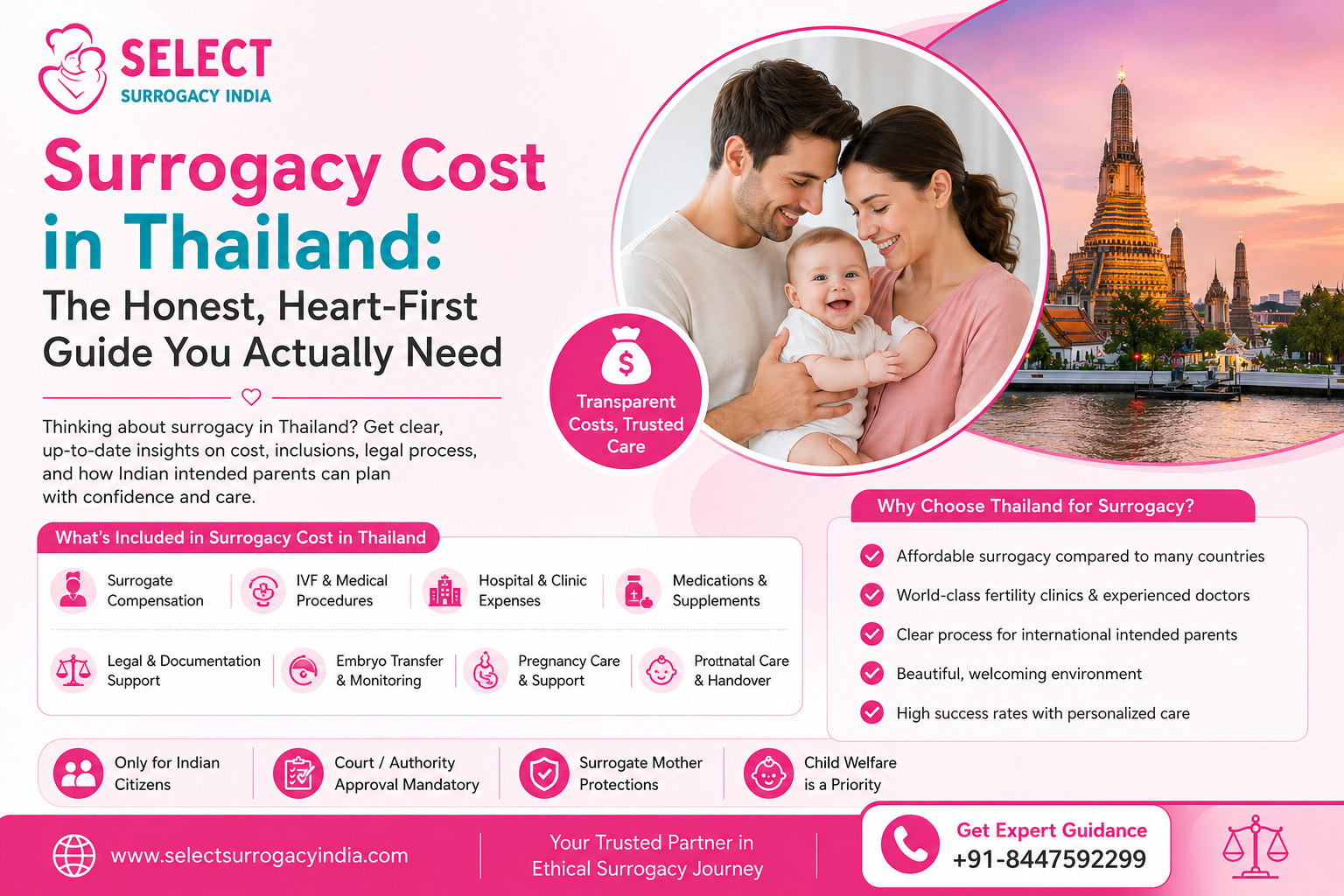
Because Thai law only permits altruistic surrogacy, there’s no large compensation payment to the surrogate herself. Instead, the costs that do apply typically cover:
- IVF and embryo creation costs (using the intended parents’ own eggs and sperm, since using the surrogate’s own egg is not permitted under Thai law)
- Medical monitoring and prenatal care for the surrogate throughout the pregnancy
- Delivery and hospital costs
- Reasonable living and travel expenses for the surrogate during the process
- Legal fees for the required government committee approval process
Because it’s such a narrow, tightly regulated pathway involving a relative rather than a matched, compensated surrogate, most families in this situation describe the financial side as being closer to covering a relative’s pregnancy-related medical and living costs, rather than paying for a service in the commercial sense. It’s genuinely hard to put a single neat number on it, because so much depends on the specific medical needs of the pregnancy, the number of IVF cycles required beforehand, and individual family circumstances.
To give you a rough sense of the moving pieces, though: IVF and embryo creation alone in Thailand typically runs somewhere between USD 3,500 and USD 8,000 per cycle, and many families need more than one cycle before achieving a viable pregnancy. Prenatal care and delivery costs vary depending on the hospital and any complications that arise, but a straightforward delivery at a good private hospital in Thailand might run a few thousand dollars, while a more complex delivery involving a longer hospital stay could cost more. Government committee approval, required before any legal altruistic surrogacy arrangement can proceed, involves its own administrative and legal fees, which families typically arrange through a lawyer familiar with the process. Altogether, families going through this narrow legal pathway often find their total costs land somewhere in a moderate range compared to full commercial surrogacy elsewhere — but again, this is a genuinely case-by-case picture, not a fixed package price you could book off a website.
It’s also worth being upfront that because this pathway is so narrow — requiring a Thai spouse, a specific relative as the surrogate, and formal government committee approval — it simply isn’t a realistic option for the vast majority of couples researching this topic, even those who deeply wish it could be. If that describes your situation, please don’t feel like you’ve failed at some kind of research task. This is genuinely a complicated, evolving area of law, and feeling confused by it is a completely normal reaction, not a sign you’ve missed something obvious.
Why We’re Not Going to Hand You a Confident Price List Here
We know it might feel a little frustrating that this guide isn’t giving you a clean “surrogacy in Thailand costs exactly $X” answer. But here’s why that matters: giving you a confident number right now, for a service that isn’t currently accessible to most foreign couples, wouldn’t actually be helpful — it would just be repeating outdated or misleading information that could send you toward a risky, potentially unlawful arrangement.
The U.S. Embassy in Thailand, along with several other Western embassies, has specifically advised against pursuing commercial surrogacy arrangements in the country, precisely because of the legal risk involved for intended parents, the surrogate, and — most importantly — the legal status and citizenship of the resulting child. Families who’ve gone down grey-market routes in the past have faced genuinely painful complications: unclear parentage documentation, difficulty obtaining citizenship or exit permission for the baby, and in some cases, real legal jeopardy. This isn’t the kind of risk worth taking on something this precious.
Let’s talk through what those complications can actually look like in practice, because the phrase “legal risk” can feel abstract until you understand what it means for a real family. In some past cases involving unregulated arrangements, intended parents have faced delays of many months trying to prove their legal parentage of a child born through an informal surrogacy arrangement, since Thai law simply doesn’t recognise the intended parents as the legal parents in these situations the way a proper legal framework would. That can mean struggling to get a passport issued, struggling to leave the country with your own baby, and in the most serious cases, facing questions from Thai authorities about how the arrangement was made in the first place. None of this is meant to frighten you unnecessarily — it’s meant to explain, plainly, why “the price seems reasonable” simply isn’t enough information to move forward on something this significant.
There’s also a genuinely important ethical layer here that’s worth naming honestly. Because commercial surrogacy is banned specifically to prevent the kind of financial pressure that can push vulnerable women into risky pregnancies without full legal protection, any arrangement that quietly works around that ban tends to recreate exactly the harm the law was designed to prevent — just with less oversight, not more. A genuinely caring approach to building your family shouldn’t come at the cost of someone else’s safety and legal protection, even unintentionally.
What Should You Actually Do If You Were Hoping for Thailand?
If Thailand was your original plan, take a breath — you still have good options, they’ll just look a little different than you first imagined.
Keep an eye on the 2026 legislative process. If you genuinely have a connection to Thailand — perhaps a Thai spouse, or Thai family ties — it’s worth following the outcome of the current public consultation closely. If the revised bill passes, the legal landscape could shift meaningfully, though likely with strict eligibility rules attached.
Consider IVF in Thailand instead, paired with surrogacy elsewhere. Thailand remains a genuinely excellent, affordable destination for IVF and embryo creation, even though surrogacy itself isn’t currently accessible there for most foreign couples. Some families choose to complete embryo creation in Thailand, where IVF costs are notably lower, and then transfer those embryos to a country where surrogacy is legally available to them.
Look into countries where surrogacy is legally established for international couples. A number of destinations have clear, well-regulated legal frameworks specifically built to support international intended parents, including parts of the United States (particularly states like California and Nevada), Colombia, and Georgia. Costs and legal requirements vary significantly by country, so this deserves its own dedicated research, but each of these offers something Thailand currently doesn’t: legal clarity for foreign parents from the very start.
To give you a rough sense of how these destinations compare, here’s a very general overview of typical total surrogacy journey costs, including medical, legal, and surrogate compensation where applicable:
| Destination | Total Cost (USD) | Legal Status for Foreign Couples |
| United States (e.g. California, Nevada) | $100,000 – $200,000+ | Well-established, clear legal framework |
| Georgia | $40,000 – $65,000 | Legal for heterosexual married couples |
| Colombia | $60,000 – $90,000 | Legal, growing international framework |
| Thailand (foreign couples) | Not currently accessible | Illegal for fully foreign couples |
The United States sits at the higher end of the range, but also offers some of the strongest legal protections in the world for intended parents, with well-established case law and, in many states, pre-birth orders that name intended parents on the birth certificate immediately, removing a lot of the uncertainty families worry about elsewhere. Georgia has become popular partly because of its more moderate costs and a legal framework specifically built around supporting foreign intended parents, though it’s currently limited to heterosexual married couples. Colombia has grown quickly as a destination in recent years, offering a middle ground between cost and legal clarity, with English-speaking legal teams increasingly available to guide international families through the process.
It’s genuinely worth spending real time comparing these options with a specialist rather than picking based on cost alone, since the legal framework, timeline, and citizenship process for your future child can vary enormously between countries — and those differences matter just as much as the price tag, if not more.
Talk to a genuine, licensed international fertility or family-law consultant. Rather than relying on informal advice from forums or agencies eager to close a sale, a proper consultation with a fertility law specialist familiar with cross-border surrogacy can save you enormous heartache, and help you map out a path that’s actually legally sound for your specific citizenship and family situation.

What Does the Legal Pathway Actually Look Like, Step by Step?
For the small number of families who do qualify — a Thai spouse married to a foreign partner for at least three years, with a willing relative to act as surrogate — it helps to understand what the actual process looks like, since it’s quite different from the streamlined “sign up and go” experience you might picture from commercial surrogacy programs elsewhere.
It typically begins with a formal application to Thailand’s surrogacy oversight committee, a government body established specifically to review and approve these arrangements before any medical procedure can begin. This isn’t a quick administrative rubber stamp — the committee reviews the marital history of the intended parents, confirms the relative relationship between the surrogate and the intended parents, and verifies that no commercial payment is planned beyond permitted expenses. This approval process alone can take weeks to months, depending on how complete the documentation is when submitted.
Once approved, the medical process begins much like standard IVF: the intended parents’ eggs and sperm are used to create embryos in the lab, since Thai law specifically prohibits using the surrogate’s own egg — this is what’s known as gestational surrogacy, where the surrogate carries the pregnancy but has no genetic connection to the child. After embryo creation, one or more embryos are transferred into the surrogate, and the pregnancy proceeds under the medical supervision of the fertility clinic, with regular monitoring throughout.
Because the surrogate is a relative rather than someone matched through a formal agency, much of this journey involves navigating an existing family relationship under new, emotionally complex circumstances — something that requires its own kind of preparation and support, separate from the medical and legal logistics. Many families in this situation describe leaning heavily on counselling support throughout the process, not because anything is wrong, but because it’s simply a lot to hold for everyone involved, including the surrogate herself and her own immediate family.
After birth, legal parentage documentation is finalised based on the pre-approved arrangement, which is part of why the upfront committee approval matters so much — it’s what allows the intended parents to be recognised as legal parents without the kind of after-the-fact legal scrambling that unregulated arrangements can create.
Watching Out for Red Flags If You’re Still Exploring Thailand
If you do have a genuine connection to Thailand, or you’re simply keeping an eye on the situation in case the 2026 legislative reform passes, it’s worth knowing what red flags to watch for so you can protect yourself while you wait and research. This section is worth bookmarking, honestly, because these same warning signs tend to show up across grey-market arrangements in other countries too, not just Thailand — so the pattern-recognition skills you build here will genuinely serve you well no matter where your journey eventually leads.
Be cautious of anyone who quotes a confident total price before understanding your citizenship situation. A legitimate provider working within Thai law will ask detailed questions about your marital status, nationality, and family relationships before offering any kind of estimate, because eligibility genuinely depends on these details.
Be wary of pressure to move quickly. Genuine legal pathways involve government committee review, which simply cannot be rushed. Any agency pushing you toward a fast timeline for a Thailand arrangement as a fully foreign couple is very likely operating outside the current legal framework.
Ask directly about the surrogate’s compensation structure. If an agency describes a clear “surrogate fee” beyond reasonable medical and living expenses, that’s a direct sign the arrangement doesn’t align with Thailand’s altruistic-only model.
Request to see documentation of prior government committee approvals. Legitimate providers working within the legal framework should be able to speak clearly and specifically about this process, not vaguely reference “connections” or “special arrangements.”
Trust your gut if something feels rushed, secretive, or overly reassuring. This is one of those situations where if it feels too smooth, too fast, or too good to be true relative to what you now know about Thai law, it probably is.
Ask direct questions about worst-case scenarios. A trustworthy specialist or agency will be willing to walk you through what happens if a pregnancy doesn’t proceed as planned, if documentation is delayed, or if a committee application is rejected — rather than only presenting the best-case timeline. If nobody wants to talk through contingencies with you, that hesitation itself is worth noticing.
If your head is spinning a little right now, that’s completely okay. Let’s turn all of this into something a bit more actionable, broken into manageable steps rather than one overwhelming decision.
Step one: pause on any Thailand-specific commitments. If you’ve already been in conversation with an agency promising surrogacy in Thailand as a fully foreign couple, it’s worth pressing pause and asking them directly, in writing, exactly how their arrangement complies with current Thai law. A legitimate, careful provider will welcome that question rather than deflect it.
Step two: get one proper consultation with an independent fertility law specialist. Not a clinic, not an agency with something to sell you — an independent lawyer or consultant who specialises in cross-border reproductive law. Many offer initial consultations specifically to help families understand their options based on citizenship, marital status, and personal circumstances. This single conversation can save you months of confusion.
Step three: make a shortlist of two or three legally clear destinations. Rather than trying to research every possible country at once, narrow your focus to two or three destinations with well-established legal frameworks for your specific situation, and go deep on those rather than wide across dozens of options.
Step four: separate your IVF planning from your surrogacy planning. If Thailand’s affordable IVF pricing was part of the original appeal, remember you can still pursue embryo creation there if it makes sense for your budget, and then transfer those embryos to your chosen surrogacy destination. This “split journey” approach is increasingly common among international families and can genuinely offer real cost savings without compromising on legal safety.
If this route interests you, it’s worth thinking through the logistics early rather than as an afterthought. Embryos created in Thailand will need to be properly frozen, documented, and shipped internationally to your chosen surrogacy destination, which involves its own set of regulations, courier requirements, and sometimes additional fees for cross-border transport of genetic material. A good fertility clinic in Thailand will have handled this kind of international shipment before and can walk you through the paperwork, but it’s smart to confirm this capability with any clinic you’re considering before you commit to the split-journey approach, rather than assuming every clinic offers it as a matter of course.
Step five: build in emotional support alongside the logistics. This kind of research detour — discovering that your original plan isn’t currently possible — can genuinely sting, even when you understand the reasons behind it. Consider talking to a counsellor who specialises in fertility journeys, or connecting with a support community of other intended parents navigating similar cross-border questions. You don’t have to carry the emotional weight of this alone while you’re also carrying the logistical weight.
It’s genuinely common for intended parents to feel a strange mix of emotions at this stage — relief at finally understanding the real legal picture, frustration at how much misinformation is out there, and a fresh wave of grief around yet another delay in a journey that may have already involved plenty of waiting. All of those feelings are valid at once, and none of them cancel the others out. Giving yourself permission to feel all of it, rather than rushing straight into “okay, next plan,” can actually make the following steps feel more manageable rather than less.
One More Honest Thought on “Cute” Advice Versus Real Advice
We wanted this guide to feel warm and human, because this topic deserves that kind of care — but we also didn’t want “cute and friendly” to come at the cost of leaving out something you genuinely needed to know. Sometimes the kindest thing a guide like this can do isn’t handing you the answer you were hoping for, but handing you the truth, wrapped in enough warmth that it doesn’t feel like a cold slammed door. We hope that’s exactly what this has been for you.

A Gentle, Honest Word Before You Go
We know this probably wasn’t the article you were hoping to read when you searched for the Surrogacy Cost in Thailand. Maybe you pictured a straightforward price breakdown, a clear next step, a plan you could start moving on this week. Instead, we’ve handed you something a little more complicated — but also, we hope, something that genuinely protects you.
Wanting a family is one of the most human, most understandable things in the world, and it’s completely okay to feel disappointed when a path you’d hoped for turns out to be more complicated than you expected. But please, don’t let that disappointment push you toward an agency or arrangement that skirts the actual law — the risks to your future child’s legal status, your own legal exposure, and the wellbeing of the surrogate herself are simply too serious to gamble with.
Take this as a starting point, not an ending point. Look into the countries where this path is genuinely, legally open to you. Talk to real specialists. Stay informed on Thailand’s evolving legislation if it matters to your specific situation. And above all, be gentle with yourself while you figure out the next right step — you’re allowed to take your time getting this one right.
If it helps at all, try to hold onto this thought: the families who eventually do welcome a child through surrogacy, wherever that journey takes them, almost never describe it as a straight line. It’s usually a story full of detours, closed doors, unexpected pivots, and a lot of careful, patient research exactly like what you’re doing right now. The fact that Thailand’s door isn’t currently open the way you’d hoped doesn’t mean your story ends here — it just means the next chapter looks a little different than the one you originally imagined. And honestly, so many families will tell you that the path that eventually worked wasn’t the one they started out searching for at all.
Wherever your journey takes you next — whether that’s a legally established destination abroad, a patient wait to see how Thailand’s legislation evolves, or a completely different route to parenthood you haven’t even considered yet — we’re genuinely rooting for you. This is hard, unglamorous, deeply important research, and the fact that you’ve read this far says a lot about how seriously you’re taking your family’s future. That care will serve you well, wherever this path eventually leads.
Frequently Asked Questions
Generally, no. Since 2015, Thai law has restricted surrogacy to couples where at least one spouse is Thai, using a relative as the surrogate, with no commercial payment involved. Fully foreign couples currently cannot legally pursue surrogacy in Thailand.
Not in the way most people expect. Since commercial surrogacy is banned, there’s no standard “package price” like you’d find in countries with legal commercial surrogacy. Costs for the narrow legal altruistic pathway mainly cover medical care, IVF, and reasonable living expenses rather than surrogate compensation.
As of mid-2026, Thailand’s Department of Health Service Support has opened a public consultation on a revised surrogacy bill that could allow foreign married couples limited access under strict conditions. As of now, this remains a proposal, not enacted law.
This would be illegal under current Thai law, carrying serious criminal penalties for anyone involved, including intended parents, brokers, and clinics. It can also create serious legal complications around your child’s citizenship and parentage.
Yes. IVF remains legal and widely available to married international couples in Thailand, and many families choose to complete embryo creation there before pursuing surrogacy in a country where it’s legally accessible to them.
Several countries have well-established legal frameworks for international surrogacy, including certain U.S. states, Colombia, and Georgia. Each has different costs, requirements, and timelines, so it’s worth researching each option carefully with a qualified specialist.
Approach any such offer with real caution. If an agency is confidently arranging commercial surrogacy in Thailand for fully foreign couples today, that arrangement likely falls outside current Thai law, and the legal, financial, and emotional risks can be significant.
Under current law, if you’ve been legally married for at least three years, you may qualify for the narrow altruistic surrogacy pathway, provided a willing relative can act as the surrogate and your application is approved by the government oversight committee. It’s worth consulting a Thai family law specialist to understand your specific eligibility.
Because it involves government committee approval before any medical procedure can begin, plus the IVF process itself and a full pregnancy term, families in this pathway often describe a total timeline of well over a year from initial application to birth, depending on how quickly documentation is processed and how many IVF cycles are needed.
That depends entirely on your personal timeline and how much uncertainty you’re comfortable holding. Some families choose to pursue a clearly legal destination now rather than wait on pending legislation, while others with a genuine connection to Thailand may feel it’s worth following the process closely. A fertility law specialist can help you weigh this decision against your own circumstances and timeline.
Read More:-
- Surrogacy Cost in Ethiopia — A Complete Guide for 2026
- Top 10 Best IVF Centre in Abu Dhabi — A Complete Guide for 2026
- IVF Cost in Abu Dhabi: A Real, Friendly Guide to What You’ll Actually Pay
- Top 10 IVF Clinics in the World: A Warm, Honest Guide for Your Fertility Journey
- Best IVF Doctors in India: A Complete Guide to India’s Top Fertility Specialists

Medically Reviewed By: Select Surrogacy India Medical Team (Fertility Experts & IVF Specialists)
Our content is reviewed by experienced fertility specialists and IVF professionals associated with Select Surrogacy India, ensuring accurate, up-to-date, and reliable information for intended parents.
✔ IVF Treatment Guidance✔ Surrogacy Consultation✔ Egg Donation Support
👉 Content reviewed for accuracy and latest IVF & surrogacy laws in India