There comes a point in every fertility journey where the questions stop being purely medical and start becoming financial. How much will this actually cost? What does insurance cover? Are there hidden expenses nobody warned us about? And most importantly — can we actually afford this?
If you are exploring IVF in Japan — whether as a Japanese resident, an expat living in Tokyo, or an international couple considering Japan as a fertility destination — this guide is written for you. Not as a brochure. Not as a sales pitch. But as an honest, detailed, and genuinely useful breakdown of what IVF in Japan costs in 2026, why it costs what it does, and how to plan your journey without financial surprises.
Japan occupies a unique position in the world of fertility treatment. It is one of the most experienced IVF nations on earth — with the first Japanese IVF baby born at Tōhoku University back in 1983, and over 850,000 IVF babies born since. It also performs more IVF cycles per capita than almost any other country in the world. And since April 2022, Japan became one of the few large economies to bring IVF under national health insurance — a landmark shift that changed the financial landscape for couples across the country.
Yet despite all of this, the cost of IVF in Japan remains a subject of significant confusion. Insurance covers some things but not others. Local government subsidies exist in some cities but not all. Advanced procedures sit entirely outside the insurance system. And for foreigners, the picture is even less clear.
This guide cuts through all of that.

Understanding IVF in Japan — The Basics First
Before we get into costs, it helps to understand what IVF in Japan actually involves and why the country has become such a significant player in fertility medicine.
Gestational IVF — the most common form — involves stimulating the ovaries to produce multiple eggs, retrieving those eggs, fertilising them in a laboratory with sperm, culturing the resulting embryos, and transferring the best-quality embryo back into the uterus. In Japan, frozen embryo transfer (FET) cycles are far more common than fresh transfers — Japanese clinics have long preferred to freeze embryos and transfer them in a separate, more controlled cycle. This approach has contributed to Japan’s reputation for technical precision in embryology.
IVF in Japan is appropriate for:
- Couples who have been unable to conceive after 12 months of trying (or 6 months for women over 35)
- Women with blocked or damaged fallopian tubes
- Men with moderate to severe sperm factor issues (combined with ICSI)
- Couples with unexplained infertility who have failed simpler treatments like IUI
- Women with endometriosis affecting fertility
- Couples who have experienced recurrent miscarriage and require preimplantation genetic testing
Japan’s IVF success rates vary significantly by age — as they do worldwide — but clinics in major cities like Tokyo, Osaka, and Nagoya consistently report competitive success rates, particularly for women under 38.
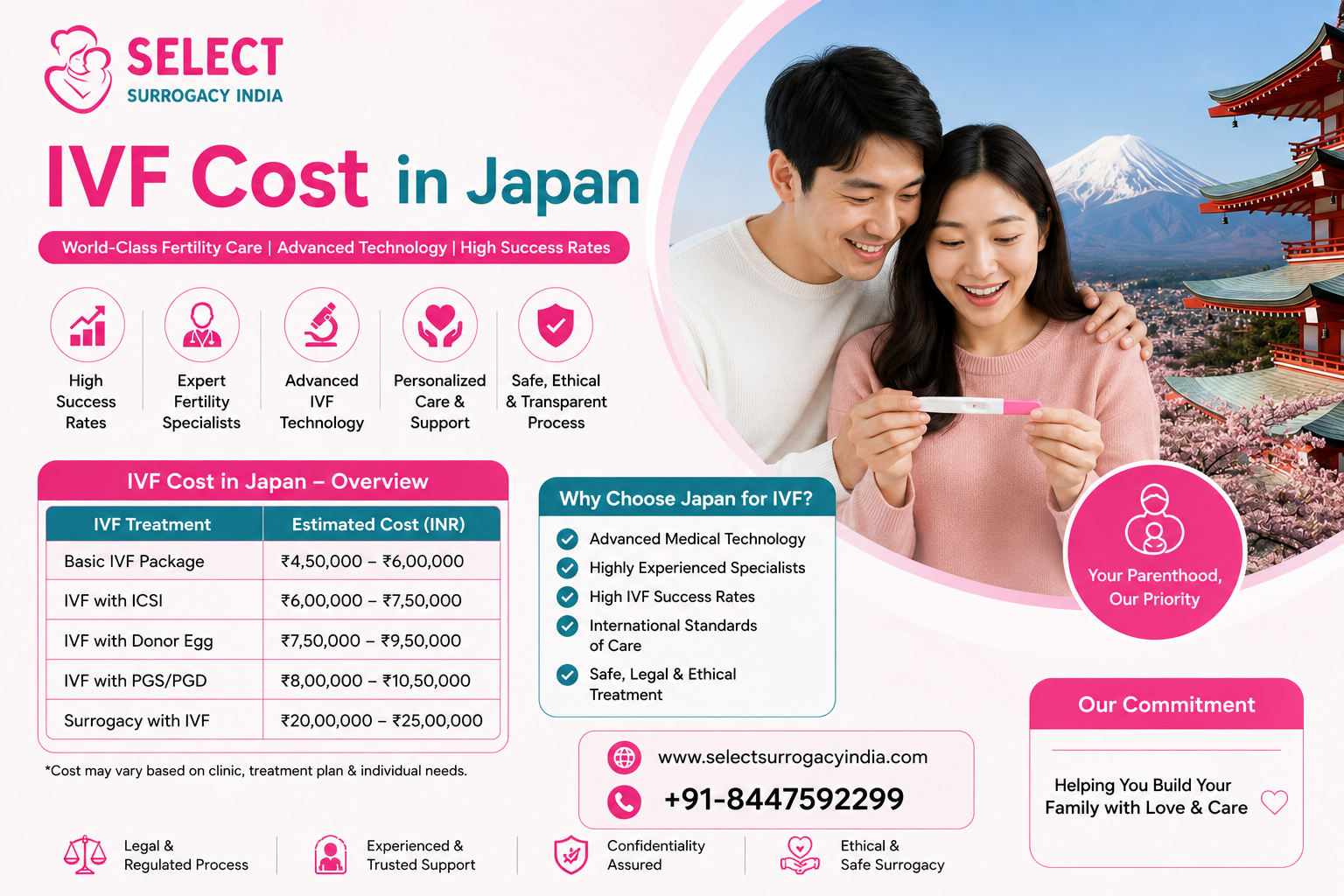
IVF Cost in Japan — The Master Summary (2026)
Let’s start with the numbers. Here is a clear overview of what IVF costs in Japan across different scenarios in 2026:
| Treatment Type | Cost in JPY | Cost in USD (approx.) |
| Basic IVF Cycle (insurance-covered, patient pays 30%) | ¥150,000 – ¥200,000 | $1,000 – $1,400 |
| Full IVF Cycle (self-pay, no insurance) | ¥400,000 – ¥600,000 | $2,700 – $4,100 |
| IVF with ICSI (self-pay) | ¥500,000 – ¥750,000 | $3,400 – $5,100 |
| Frozen Embryo Transfer (FET) — insurance covered | ¥50,000 – ¥80,000 | $340 – $540 |
| Frozen Embryo Transfer (FET) — self-pay | ¥100,000 – ¥200,000 | $680 – $1,350 |
| IVF with Donor Eggs (not covered by insurance) | ¥800,000 – ¥1,500,000 | $5,400 – $10,100 |
| PGT-A Genetic Testing (advanced, self-pay) | ¥300,000 – ¥600,000 | $2,000 – $4,050 |
| Cumulative cost (multiple cycles, self-pay) | ¥1,500,000 – ¥3,000,000 | $10,100 – $20,200 |
These numbers tell a story that surprises many people — IVF in Japan, particularly under the national insurance system, is among the most affordable in any developed country. The catch, as we will explore below, is what insurance covers and what it does not.
The 2022 Insurance Revolution — What Changed and Why It Matters
April 1, 2022 is a date that fertility specialists across Japan remember clearly. On that day, the Japanese government brought IVF and other assisted reproductive technologies (ART) under the national health insurance (shakai hoken / kokumin kenko hoken) system for the first time.
Before 2022, IVF was almost entirely self-funded. A single cycle cost ¥400,000 to ¥500,000 out of pocket — more than the average Japanese household’s monthly income. The government had provided some subsidies previously, but access was patchy, eligibility was limited, and the financial burden remained substantial.
The 2022 reform changed this fundamentally. Under the new system, patients pay only 30% of the cost of standard IVF treatment, with the national insurance covering the remaining 70%. For a ¥500,000 cycle, this means the patient’s out-of-pocket cost drops to roughly ¥150,000 — a dramatic reduction.
However, the insurance coverage comes with conditions that every couple must understand:
Who is eligible:
- Married couples (as of 2026, the insurance system primarily covers legally married couples, though policy discussions around expanding eligibility are ongoing)
- Women up to the age of 43 at the time of embryo transfer
- A maximum of six covered cycles per child for women under 40, and three covered cycles for women aged 40 to 42
What is covered:
- Ovarian stimulation (standard protocols)
- Egg retrieval procedure
- Basic embryo culture and fertilisation
- Frozen embryo transfer (FET)
- Basic monitoring and blood tests during treatment
What is NOT covered:
- Preimplantation Genetic Testing (PGT-A, PGT-M)
- Time-lapse embryo monitoring systems
- ERA (Endometrial Receptivity Analysis)
- Donor egg cycles
- Donor sperm (for fertility purposes beyond standard male factor)
- SEET procedure and other advanced endometrial preparation techniques
- Some medications used in non-standard stimulation protocols
This distinction matters enormously in practice. Many couples find that their specific treatment needs — particularly if they have had repeated implantation failure, recurrent miscarriage, or are older — require precisely the add-ons that fall outside the insurance system. The result is a treatment journey that mixes insured and non-insured components, producing a total cost that can be significantly higher than the basic insurance figures suggest.
Component-by-Component Cost Breakdown
Understanding the total IVF cost in Japan requires looking at each stage of treatment individually. Here is how the costs break down in practice.
1. Initial Consultations and Diagnostic Testing
Before IVF begins, both partners require a series of diagnostic tests to establish their baseline fertility profile and identify the cause of infertility.
| Diagnostic Component | Estimated Cost (JPY) |
| Initial fertility consultation | ¥3,000 – ¥8,000 |
| AMH (ovarian reserve) blood test | ¥5,000 – ¥15,000 |
| Antral follicle count (ultrasound) | ¥3,000 – ¥8,000 |
| Hormone panel (FSH, LH, E2, prolactin) | ¥8,000 – ¥20,000 |
| Semen analysis | ¥5,000 – ¥15,000 |
| Hysteroscopy or HSG (uterine assessment) | ¥15,000 – ¥40,000 |
| Infectious disease screening (both partners) | ¥10,000 – ¥25,000 |
| Total diagnostics (estimated) | ¥50,000 – ¥130,000 |
Many of these basic diagnostic tests are covered under the national insurance system, particularly those that fall under standard infertility workup. The costs above reflect the 30% patient co-payment after insurance.
2. Ovarian Stimulation and Medications
Stimulation medications are one of the largest cost variables in any IVF cycle. Japan uses a range of stimulation protocols — from mild/minimal stimulation (which is particularly common in Japanese clinics and involves lower doses of medication) to standard and high-dose protocols for patients with diminished ovarian reserve.
| Medication Component | Estimated Cost (JPY) |
| Gonadotropins (FSH injections) — mild protocol | ¥30,000 – ¥80,000 |
| Gonadotropins — standard/high protocol | ¥80,000 – ¥200,000 |
| GnRH antagonist or agonist | ¥20,000 – ¥50,000 |
| Trigger shot (hCG or GnRH agonist) | ¥3,000 – ¥10,000 |
| Luteal phase support (progesterone) | ¥10,000 – ¥30,000 |
| Total medications (estimated, insurance co-pay) | ¥50,000 – ¥150,000 |
Japan’s fertility clinics — particularly in Tokyo — have historically favoured mild stimulation protocols that use lower medication doses to produce fewer but higher-quality eggs. This approach typically reduces medication costs and is gentler on the patient’s body, though it may produce fewer embryos per cycle.
3. Egg Retrieval (Oocyte Pick-Up)
The egg retrieval procedure is performed under sedation or light general anaesthesia and typically takes 20 to 30 minutes. In Japan, most clinics perform retrievals as a day procedure, meaning no overnight hospital stay is required.
| Retrieval Component | Cost (JPY, insurance co-pay) |
| Anaesthesia/sedation | ¥10,000 – ¥25,000 |
| Retrieval procedure fee | ¥30,000 – ¥70,000 |
| Monitoring scans (3-5 visits during stimulation) | ¥15,000 – ¥40,000 |
| Total retrieval (estimated) | ¥55,000 – ¥135,000 |
4. Embryology Laboratory Fees
Japan is internationally respected for the quality of its embryology laboratories. Major fertility centres use advanced culture systems, sophisticated incubators, and vitrification (rapid-freeze) techniques that Japan helped pioneer. The Cryotec method — a vitrification technique developed in Japan — is now used worldwide.
| Laboratory Component | Cost (JPY) |
| Fertilisation and embryo culture (standard) | ¥30,000 – ¥80,000 |
| ICSI (intracytoplasmic sperm injection) | ¥30,000 – ¥70,000 |
| Embryo vitrification (freezing, per embryo batch) | ¥20,000 – ¥50,000 |
| Annual embryo storage | ¥20,000 – ¥40,000/year |
| Time-lapse monitoring (EmbryoScope — self-pay) | ¥50,000 – ¥100,000 |
| Total laboratory (estimated, basic) | ¥80,000 – ¥200,000 |
5. Frozen Embryo Transfer (FET)
Because Japan almost universally freezes embryos and transfers them in a subsequent cycle, the FET is effectively a separate cost stage. Under insurance, FETs are among the most affordable parts of the treatment journey.
| FET Component | Insured Cost (JPY) | Self-Pay (JPY) |
| Endometrial preparation | ¥10,000 – ¥25,000 | ¥25,000 – ¥60,000 |
| Monitoring scans pre-transfer | ¥8,000 – ¥20,000 | ¥15,000 – ¥35,000 |
| Transfer procedure | ¥20,000 – ¥50,000 | ¥50,000 – ¥100,000 |
| Luteal support medications | ¥8,000 – ¥20,000 | ¥15,000 – ¥40,000 |
| Total FET (estimated) | ¥50,000 – ¥80,000 | ¥100,000 – ¥200,000 |
Advanced Treatments — The Self-Pay Zone
Here is where IVF costs in Japan can rise significantly. Several advanced procedures that many couples require are explicitly excluded from insurance coverage and must be funded entirely out of pocket. Understanding this is essential for accurate financial planning.
Preimplantation Genetic Testing (PGT-A / PGT-M)
PGT-A tests embryos for chromosomal abnormalities before transfer, identifying euploid (chromosomally normal) embryos. PGT-M is a customised test for couples who carry known genetic mutations. Both are widely available in Japan but fall entirely outside insurance coverage.
- PGT-A: ¥300,000 – ¥600,000 for testing a batch of embryos
- PGT-M: ¥500,000 – ¥1,000,000+ (highly case-specific)
For couples who have experienced recurrent miscarriage or repeated implantation failure, PGT-A can significantly reduce the number of failed transfers — making it cost-effective overall despite its upfront expense.
ERA (Endometrial Receptivity Analysis)
ERA testing identifies the precise window of implantation for each individual woman — allowing the FET to be timed more accurately. It adds ¥100,000 – ¥200,000 to a cycle’s cost but is increasingly used in Japan’s top fertility centres for patients with unexplained failed transfers.
Donor Egg IVF
Donor egg IVF in Japan sits in a complicated position. The Japan Society of Obstetrics and Gynecology has historically had strict guidelines around donor egg use, and not all clinics offer it. Where it is available, it is entirely self-funded:
- Donor egg IVF (domestic): ¥800,000 – ¥1,500,000
- Donor egg IVF (with overseas donor coordination): ¥1,000,000 – ¥2,000,000+
Surgical Sperm Retrieval (TESE/Micro-TESE)
For men with azoospermia (no sperm in ejaculate), surgical retrieval is sometimes necessary. This procedure, while medically necessary, involves a specialist surgical team:
- TESE: ¥100,000 – ¥200,000
- Micro-TESE: ¥200,000 – ¥500,000
City-by-City Cost Comparison in Japan
Location matters when it comes to IVF costs in Japan. Tokyo and other major metropolitan areas have the highest concentration of specialist fertility clinics but also carry premium pricing. Here is how costs typically compare:
| City/Region | Average Single IVF Cycle Cost (self-pay) | Notes |
| Tokyo (central) | ¥500,000 – ¥700,000 | Highest cost, most clinics, best English support |
| Osaka | ¥450,000 – ¥650,000 | Strong clinic concentration |
| Nagoya | ¥400,000 – ¥580,000 | Good value, experienced centres |
| Fukuoka | ¥380,000 – ¥550,000 | Lower cost, high-quality clinics |
| Sapporo | ¥350,000 – ¥500,000 | Lowest major-city pricing |
| Regional cities | ¥300,000 – ¥450,000 | Fewer clinic options |
Tokyo’s fertility clinics — including renowned centres like Sanno Hospital, Lucia Clinic, Kato Ladies Clinic, and Kitasato University Hospital — offer the most advanced services and the broadest experience with international patients, but come with the highest price tags. Fukuoka and Nagoya offer meaningful savings with no real compromise in clinical quality for most patients.
Government Subsidies and Local Government Support
Beyond national insurance, many Japanese local governments provide additional financial assistance for fertility treatment. As of 2025, approximately 70% of major local governments across Japan offer supplementary subsidies on top of the national insurance system, recognising that even with 70% coverage, the cumulative cost of multiple cycles creates a real financial burden.
Tokyo’s program, which made international headlines in early 2026, offers up to ¥300,000 ($2,000) toward egg freezing for women aged 18 to 39 — a notable departure from earlier programs that excluded unmarried women.
Other municipalities offer cash subsidies for specific procedures not covered by national insurance, reduced-rate loans for fertility treatment, and in some cases, free counselling services.
The practical advice: before starting treatment, contact your local ward office (ku-yakusho) or municipal government to understand exactly what additional support is available in your specific area. The landscape changes regularly and varies meaningfully between prefectures.
Japan vs Other Countries — IVF Cost Comparison
For international couples or residents weighing Japan against other destinations, here is an honest 2026 comparison:
| Country | Average IVF Cost per Cycle (USD) |
| Japan (insured, patient pays 30%) | $1,000 – $1,400 |
| Japan (self-pay) | $2,700 – $4,100 |
| South Korea | $3,000 – $5,000 |
| India | $2,000 – $4,000 |
| Thailand | $4,000 – $6,000 |
| Spain | $5,000 – $8,000 |
| United Kingdom | $6,000 – $10,000 |
| Australia | $8,000 – $12,000 |
| United States | $12,000 – $20,000 |
For Japanese residents with national health insurance, Japan’s IVF costs are genuinely among the lowest of any developed nation — representing extraordinary value for the quality of care provided. Even for self-paying patients, Japan compares very favourably against the USA, UK, and Australia.
The Real Total: What Couples Actually Spend
The honest conversation about IVF costs is not about a single cycle. It is about the total financial commitment across a complete journey — because not everyone conceives on the first transfer.
Research published in 2025 found that among patients who pursued IVF in Japan, 83.9% underwent up to five cycles. The cumulative cost for patients who required multiple cycles frequently exceeded ¥2,500,000 ($16,800) — even under the insurance system, because advanced add-ons, medications, and non-insured procedures accumulate rapidly.
Here is what a realistic journey might look like financially:
Scenario 1: Woman under 35, straightforward case, conceives on first FET
- Diagnostics: ¥80,000
- Stimulation and retrieval: ¥100,000
- Laboratory fees: ¥80,000
- One FET: ¥60,000
- Total: approximately ¥320,000 ($2,150)
Scenario 2: Woman aged 38, requires PGT-A, conceives on second FET
- Diagnostics: ¥100,000
- Stimulation and retrieval: ¥130,000
- Laboratory + PGT-A: ¥500,000
- Two FETs: ¥120,000
- Total: approximately ¥850,000 ($5,700)
Scenario 3: Woman over 40, three stimulation cycles, donor consideration
- Diagnostics: ¥130,000
- Three stimulation + retrieval cycles: ¥450,000
- Laboratory fees: ¥200,000
- PGT-A: ¥450,000
- Four FETs: ¥240,000
- Total: approximately ¥1,470,000 ($9,900)
These scenarios are illustrative — every case is different — but they give a realistic sense of how total costs scale with complexity and age.
Hidden Costs Most Guides Never Mention
Beyond the clinic fees, several additional costs deserve attention in your financial planning.
Time off work. IVF in Japan involves frequent clinic visits — often 8 to 12 appointments per cycle for monitoring, injections, retrieval, and transfer. Japanese clinics are well-organised and typically efficient, but mornings spent waiting can add up. For some patients, this means significant use of annual leave or, in some cases, income loss.
Transportation costs. Particularly for patients who travel from suburban or regional areas to clinics in central Tokyo or Osaka, transport costs across a full treatment journey can reach ¥50,000 – ¥100,000.
Counselling and emotional support. IVF is emotionally demanding. Investing in professional counselling — whether at the clinic or independently — is not a luxury. Budget ¥10,000 – ¥30,000 for structured support across your journey.
Nutritional supplements and lifestyle adjustments. Many Japanese fertility specialists recommend specific supplements — CoQ10, DHEA, vitamin D, omega-3s — particularly for older patients. Quality supplements appropriate for fertility add ¥10,000 – ¥30,000 per month.
Second opinions and clinic transfers. Some couples switch clinics after failed cycles. Japan’s healthcare system makes this relatively easy, but new diagnostic testing at a new clinic can add ¥50,000 – ¥100,000.
Tips for Managing IVF Costs in Japan
Maximise your insurance eligibility first. If you are eligible for national insurance coverage, ensure your clinic is an officially registered insurance-covered fertility centre (hoken shinryo kikan). Not all clinics participate in the insurance system — confirm before booking.
Check local government subsidies proactively. Visit your ward or municipal office before starting treatment. Many local governments offer additional subsidies — particularly for procedures not covered by national insurance — that could save you ¥100,000 – ¥300,000.
Freeze surplus embryos wisely. If a stimulation cycle produces multiple good-quality embryos, freezing the surplus is among the most financially intelligent decisions you can make. A frozen embryo transfer costs a fraction of a fresh cycle, and having frozen embryos in reserve removes the financial and physical burden of repeating stimulation.
Ask about instalment payment plans. Several major fertility clinics in Japan — and Kato Ladies Clinic in Shinjuku is particularly well known for this — offer clear, staged payment structures. This spreads financial outlay across the treatment journey and reduces the upfront burden of large single payments.
Build a 20% contingency reserve. Always budget 20% above your estimated cycle cost. Medications sometimes need increasing. Additional monitoring visits happen. Unexpected procedures arise. Having this buffer means you never face the pressure of making a medical decision based on a financial constraint.
Understand what you are paying for before you commit. Japan’s clinics are generally excellent at itemising costs, but the mixture of insured and self-pay components in a single cycle can create confusion. Ask your clinic for a full written cost estimate covering both insurance-covered and self-pay components before each stage of treatment begins.
IVF in Japan as a Foreigner — Special Considerations
Japan has a significant expat community, and many foreigners living in Japan seek fertility treatment here. The experience differs in a few important ways.
National health insurance eligibility. Both the Employee Health Insurance (shakai hoken) and the National Health Insurance (kokumin kenko hoken) systems are generally available to registered foreign residents who meet standard eligibility criteria. If you are enrolled in either system and meet the age and eligibility criteria for covered IVF, you can access the same insurance benefits as Japanese nationals. This is a significant advantage for long-term residents.
Language barriers. While Japan has excellent fertility medicine, the healthcare system is primarily Japanese-language. Major clinics in Tokyo — particularly those in international districts like Minato, Shinjuku, and Shibuya — have English-speaking coordinators or concierge services. Clinics such as Fertility Clinic Tokyo and Sanno Hospital explicitly cater to international patients. For less Japanese-fluent patients, choosing one of these clinics from the outset avoids significant communication difficulties at an already stressful time.
Medical records and documentation. If you have undergone fertility testing or previous IVF cycles in another country, bring complete documentation — translated into Japanese if possible. Previous AMH results, semen analyses, embryology reports, and treatment summaries help Japanese clinics plan your protocol without repeating expensive diagnostics.
Choosing the Right Clinic in Japan
The quality of your fertility clinic and the experience of your specialist matter as much as cost. Japan has hundreds of fertility centres, ranging from large dedicated IVF hospitals to smaller specialist outpatient clinics. Key considerations when choosing include:
Published success rate data. The Japanese Society of Obstetrics and Gynecology (JSOG) publishes annual ART statistics, including cycle numbers and pregnancy rates by clinic and age group. These statistics are publicly available and allow meaningful comparison.
Laboratory quality. The embryology lab is the heart of any IVF programme. Ask about the clinic’s vitrification technique, embryo grading system, and whether they use time-lapse monitoring — even if you will not use it yourself, it reflects the lab’s overall standard.
Specialist experience with your specific condition. If you have endometriosis, recurrent implantation failure, premature ovarian insufficiency, or a specific genetic condition, seek a specialist with documented experience managing that condition rather than a generalist fertility clinic.
Accessibility and appointment availability. IVF requires frequent monitoring visits. A clinic that is genuinely accessible from your home or workplace — and that has appointment slots that work with your schedule — is a practical consideration that significantly affects your experience.
Why Select IVF India is a Trusted Choice?
1. Ethical & Legal Compliance
We strictly follow all guidelines and regulations related to IVF treatment in India. Adhering to legal and ethical standards is a top priority, ensuring that every step of the process is safe, transparent, and compliant with medical norms.
- Proper documentation at every stage
- Clear consent and legal transparency
- Patient rights and confidentiality maintained
- No unethical practices or hidden procedures
We continuously stay updated with the latest IVF regulations to ensure that all treatments are conducted in a legally secure and ethically responsible manner.
2. High Success Rates
We collaborate with some of the most advanced IVF centres and experienced embryologists in Japan. Our approach is focused on personalized treatment, which significantly improves success rates.With a success rate of over 70% in many cases, we carefully evaluate each patient’s medical condition, age, and fertility factors before designing a treatment plan. The use of advanced technology, high-quality lab facilities, and expert supervision contributes to better outcomes.
3. End-to-End Support and Care
From your first consultation to a successful pregnancy, we provide complete support throughout your IVF journey. Our team ensures that every aspect of the treatment is handled smoothly and professionally.
- Medical consultation and treatment planning
- Coordination with IVF specialists
- Diagnostic tests and procedures
- Continuous monitoring during cycles
- Support until pregnancy confirmation and beyond
We aim to make the entire process stress-free and well-managed for intended parents.
4. Transparency & Trust
We believe in complete honesty and clarity when it comes to IVF treatment. There are no hidden charges, and all costs are explained in detail before starting the procedure.Patients are kept informed at every stage, ensuring they understand the progress, procedures, and expected outcomes. Our transparent approach helps build trust and long-term confidence.
5. Personalised Care
Every individual or couple has a unique fertility journey. We create customized IVF treatment plans based on medical history, emotional needs, and financial considerations.
Our personalized approach includes:
- Tailored treatment strategies
- Emotional and psychological support
- Flexible financial planning options
- Focus on patient comfort and well-being

Final Thoughts
The IVF cost in Japan in 2026 sits in a genuinely interesting position globally. For residents with national health insurance, Japan offers among the most affordable and highest-quality IVF available anywhere in the developed world. The 2022 insurance reform was a meaningful policy shift — not perfect, not complete, but a significant reduction in the financial barrier that previously forced many couples to make heartbreaking choices between treatment and financial stability.
What Japan’s system cannot fully resolve — yet — is the cumulative cost of multiple cycles, the expense of advanced procedures that sit outside insurance coverage, and the particular challenges faced by older women for whom standard protocols often prove insufficient.
Understanding these realities from the outset is not pessimism. It is the financial clarity that allows couples to plan honestly, budget accurately, and approach their fertility journey with confidence rather than anxiety.
Japan has been helping couples build families through IVF for over four decades. Its clinics are among the most technically skilled in the world. And its costs — particularly under the insurance system — make that expertise more accessible than ever before.
If you are beginning this journey, the most important step is an honest conversation: with a specialist who can assess your individual situation, and with a financial plan that accounts for the full range of what that journey might require.
Frequently Asked Questions
Under the national health insurance system introduced in April 2022, patients pay approximately 30% of the treatment cost. For a standard IVF cycle, this means out-of-pocket costs of roughly ¥150,000 – ¥200,000 ($1,000 – $1,400). Patients are eligible for up to six covered cycles per child if under 40, or three cycles if aged 40 to 42.
Self-pay IVF in Japan typically costs ¥400,000 – ¥600,000 ($2,700 – $4,100) per cycle. With ICSI, this rises to ¥500,000 – ¥750,000. Advanced add-ons like PGT-A add further cost.
Yes — significantly. A single IVF cycle in the USA costs $12,000 – $20,000 on average. Even without insurance, Japan’s ¥400,000 – ¥600,000 cycle works out to $2,700 – $4,100 — roughly one-quarter to one-fifth of US pricing for comparable or superior laboratory quality.
Yes, foreign residents who are enrolled in Japan’s national health insurance system (shakai hoken or kokumin kenko hoken) and meet the eligibility criteria are generally able to access covered IVF treatment in the same way as Japanese nationals.
Success rates vary by age and clinic. For women under 35 using their own eggs and good-quality frozen embryos, per-transfer success rates at leading Japanese clinics range from 40% to 60%. For women over 40 without donor eggs, per-transfer success rates are typically 10% to 20%.
Yes. As of 2025, approximately 70% of major local governments in Japan offer financial assistance for fertility treatment beyond national insurance. Tokyo, Osaka, and many other prefectures have active subsidy programmes. Check with your local ward office for current eligibility and amounts.
Read More:-
- Best IVF Centres in Pakistan: Everything You Need to Know Before You Begin
- Best IVF Doctor in Pakistan: Top Specialists You Can Actually Trust in 2026
- IVF Cost in Philippines: The Complete, Honest Guide for 2026
- Best IVF Centre in Philippines – Top 12 Clinics, Cost, Success Rates & Complete Guide (2026)
- Best IVF Centre in Dubai: Top 12 Clinics You Can Trust in 2026

Medically Reviewed By: Select Surrogacy India Medical Team (Fertility Experts & IVF Specialists)
Our content is reviewed by experienced fertility specialists and IVF professionals associated with Select Surrogacy India, ensuring accurate, up-to-date, and reliable information for intended parents.
✔ IVF Treatment Guidance✔ Surrogacy Consultation✔ Egg Donation Support
👉 Content reviewed for accuracy and latest IVF & surrogacy laws in India